An historical narrative of 150 years since the founding
Saint Marys, Ohio · 1823–1973
Frank B. Shuffelton · Special chapters by K. C. Geiger
Sesquicentennial cover, 1823–1973
Published 1973 by The Leader Printing Co. and Hunter Printing, Saint Marys, Ohio, with a grant from the City of Saint Marys. Drawings by Richard J. Cromer. This page presents the book’s narrative and all 78 original page scans. Some OCR wording is cleaned for reading; open the page images for the printed original.
In presenting The Saint Marys Story, it has been the aim of the author to portray life, times, thinking, problems and plans of those who came to a wilderness and created the city as we know it today. It was felt essential to keep this work limited to the 150 year period, and at the same time to stay closely within the descriptions set down by writers of another day.
The history of Indian tribes and military expeditions are well recorded in many books. They had a certain effect on Saint Marys, but this work is limited to the people who made the community. Likewise, old courthouse recordings are not requoted here as they are still available in official files. They record facts, not feelings. This historical narrative seeks to emphasize the spirit rather than the letter of history. The goal is readability, interest and instruction.
The strength of a community lies in its people — their visions, their actions, their achievements and the disappointments they suffered. Without doubt, there are scores of items, events and people who could have (and should have) been included. The limitations of space and time are with us all. The author can only beg forgiveness and tolerance.
Appreciation is extended to the writings of John J. Hauss in The Evening Leader; Henry Howe’s Historical Collections of Ohio; the histories of Murray and Simpkins; old county atlases and records; Ohio State archives; and H. S. Knapp’s 1872 History of the Maumee Valley. The style of writing is attributed to Prof. Walter Havighurst, an early tutor of the author at Miami University. A special thank you is due Mrs. Don Cook (Doris Krogman), who translated the scribbling to typewritten form.
The Sesquicentennial Committee commends Miss Kathryn C. Geiger, editor of The Evening Leader. Fifty years earlier she was the cub reporter who “minded the store” during the Great Centennial of 1923. For a full one third of the city’s existence she recorded the births, marriages, deaths and goings-on of Saint Marys.
Now it is time for other people of vision and action to lead our city on to its Bi-Centennial in 2023!
Preface
❧
I. Three Men and a Dream
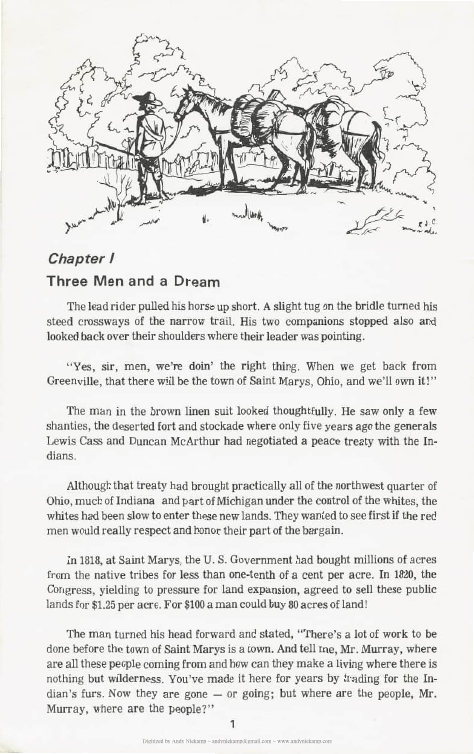
The lead rider pulled his horse up short. A slight tug on the bridle turned his steed crossways of the narrow trail. His two companions stopped also and looked back over their shoulders where their leader was pointing.
“Yes, sir, men, we’re doin’ the right thing. When we get back from Greenville, that there will be the town of Saint Marys, Ohio, and we’ll own it!”
William Houston looked at a few shanties, the deserted fort and stockade. “I see the river, I see the trail going or coming; but where are the people, Mr. Murray, where are the people?”
John McCorkle answered that they had been over it a hundred times. John Manning had done it at Piqua — a mill, grain, a store, a town. South of them was “old country.” This was the new country, and their town was the gate. “We’re at the front door to ten thousand miles of America!”
Murray pointed southward to the ring of an axe against timber — John Armstrong clearing an eighty. When the canal was dug — whooee. But first the papers had to reach Greenville.
It was a long hard day on a wilderness trail first opened by General Mad Anthony Wayne. Another trail, only fourteen miles, had been beaten by Miami, Shawnee, Wyandot, Delaware and Huron peoples between the Saint Marys River and the Great Miami at Loramie’s Store. Trading posts already stood at both ends of that portage. The three men — Murray, Houston, and McCorkle — meant to plant a town on that gate.
Chapter I opening
II. The Growing Frontier
William Houston had once asked, “Where are the people, Mr. Murray, where are the people?”
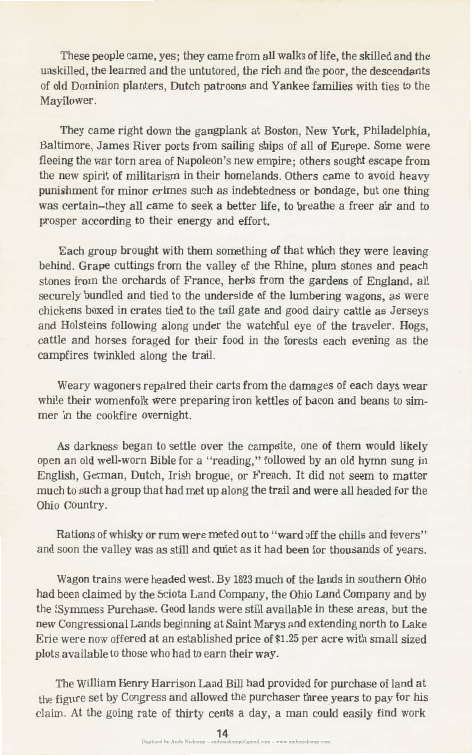
They came. They came in ox carts through unmarked wilderness trails, by river barges floated down the Ohio and pushed by poles up the Miami to the portage. They came by horseback through the Great Black Swamp to the north. They came by the long boats across Lake Erie and up the Maumee. Saint Marys would sit on the line of this new mode of transportation.
Farms were hacked from timber. Mills, stores, and a Baptist church rose. Irish from the Erie Canal and German immigrants joined the woodsmen. The town remained, in McCorkle’s words, “at the front door to ten thousand miles of America.”
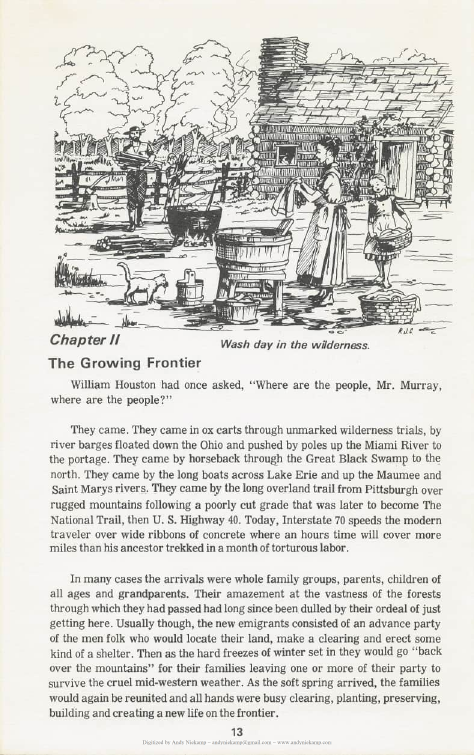
Wash day in the wilderness — Chapter II
III. The Canal Period
“Canal Fever” swept over Ohio like a tidal wave. The Erie Canal in New York had proven the system. Connecting the eastern seaboard with the Great Lakes had brought prosperity; Ohio meant to do the same from the Ohio River to Lake Erie.
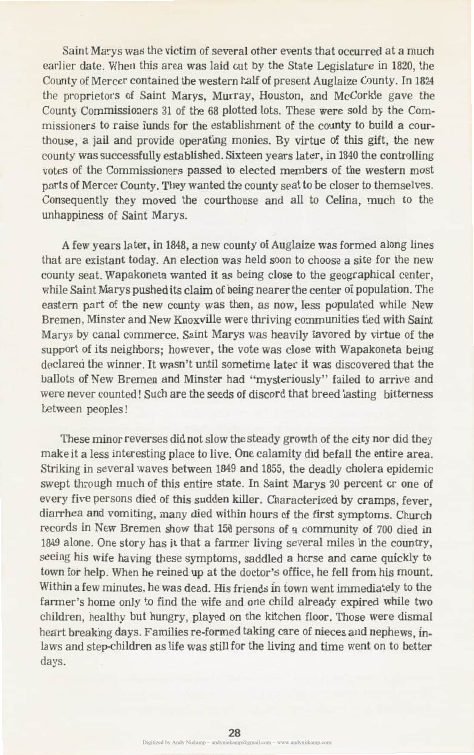
Saint Marys sat on the Miami and Erie Canal. Boats, warehouses, lock tenders, and taverns changed the little river town. Canal traffic south of Saint Marys became a daily sight. German settlement thickened in the neighboring villages of New Bremen, Minster, and New Knoxville. The canal years made Saint Marys a shipping point for grain, timber, and later manufactured goods — until the railroad began to steal the trade.
Canal traffic south of Saint Marys
IV. Some Days are Good—Some Not
Frontier luck was uneven. Fire, flood, hard winters, and epidemic years sit beside the good harvests. Civil War monuments later marked the cost of the 1860s. A railroad and a toll road to Logan County pulled the town another way. Horse-drawn fire wagons still answered the alarm into a later century.
The chapter holds both the ordinary week — wash day, market day — and the days that emptied a street: funerals, a burned block, a low river when the boats could not pass.
Monument to Civil War veterans
V. Oil Boom and Industry
Oil wells in the reservoir country and new factories pulled Saint Marys out of a purely canal economy. Derricks, tank cars, and machine shops arrived with the last decades of the nineteenth century. The boom was noisy and uneven; some families rose with it, some left when a well went dry.
Industry that stayed — metalworking, woodworking, printing — gave the town a payroll after the oil excitement cooled. The printed pages of this chapter show wells, shops, and the last of the horse-drawn fire wagons at the edge of a new age.
VI. The Beautiful Years
Before the First World War and just after it, Saint Marys remembered itself as living through “the beautiful years”: Sunday afternoons in Gordon Park, a growing hospital, the 1923 Centennial pageant under a program tent. General chairman and committee names fill the 1923 reprint pages — Fritz Limbacher, Howard Meyers, Lowell and others — and a grand finale photograph of the pageant.
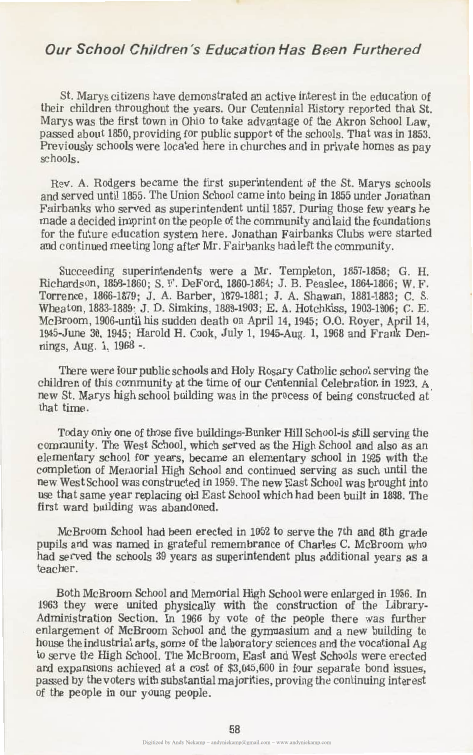
Schools multiplied. Memorial High School, McBroom, Bunker Hill, the old East and West Side buildings, Holy Rosary, and later the present elementary schools appear in the picture section. The first St. Marys High School class graduated in 1874; Anna is named among that first group.
Memorial High SchoolMcBroom and Bunker Hill schools
VII. Depression and Recovery
Banking reforms closed many banks but restored confidence in those that survived. The Depression years were lean on Main Street; recovery came slowly through New Deal work, local payrolls, and then the second world war. The author writes that many had believed America would never again be embroiled in the conflicts of the world. The 1940s proved otherwise.
After the war the city acquired park land, laid out off-street parking lots, and watched Joint Township District Memorial Hospital flourish. Mayors and council names close the civic record toward 1973. The sesquicentennial itself is the book’s last public act: a city looking toward the bicentennial of 2023.
Chapters of Special Events — Kathryn C. Geiger
K. C. “Casey” Geiger, editor of The Evening Leader, wrote the special-subject chapters that sit beside Shuffelton’s narrative.
Newspaper and News
In 1944 The Leader Printing Company directors elected H. W. Buss. In 1969 The Evening Leader made many improvements, including conversion work that kept a daily paper in a town of this size. The Leader building itself is part of the civic inventory.
Churches Established Early
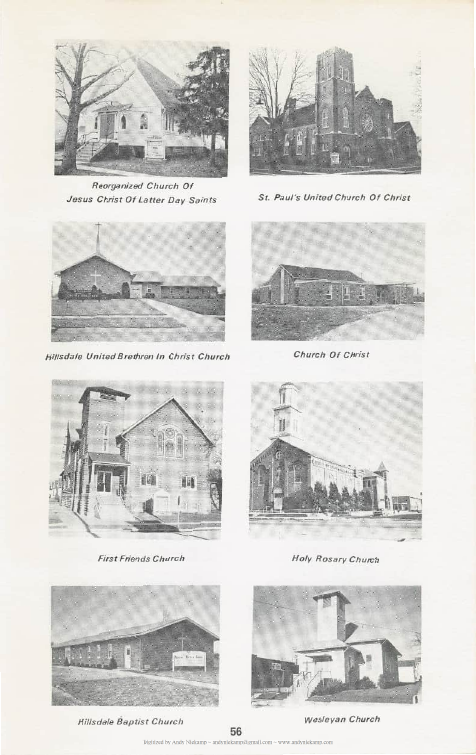
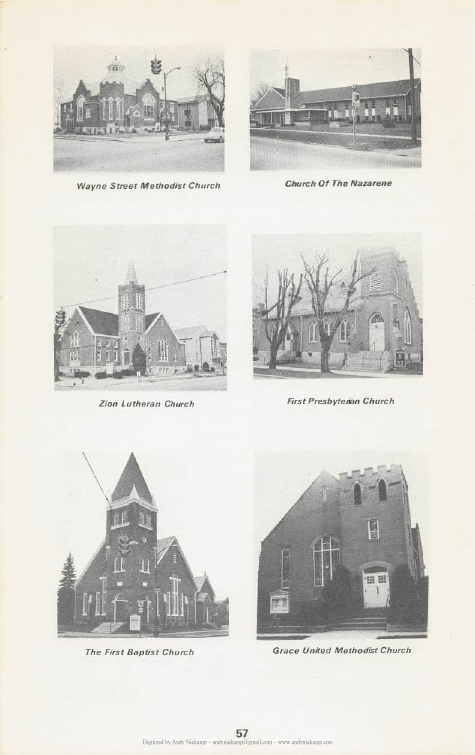
Among congregations named in 1973: St. Paul’s United Church of Christ (1849); Friends Church (1908); First Church of the Nazarene (1930); Church of Christ (1963); the Brethren congregation later merged with the Methodist Church; Holy Rosary; Wayne Street Methodist; Zion Lutheran; First Presbyterian; and the Reorganized Church of Jesus Christ of Latter Day Saints. Photographs of several of these buildings appear in the original plates.
Schools
By 1973 the St. Marys School District was served by 138 certified personnel and about 60 non-certified staff. Holy Rosary School was served by Sister Marjorie Fahey and eight teachers of the Sisters of the Precious Blood and lay faculty. The Central PTA sponsored scholarships for students headed into teaching. A joint vocational proposal to serve Mercer County plus St. Marys, New Bremen, New Knoxville and Minster had been defeated three times and was expected to return after reorganization.
Hospital, Parks, Parking
Joint Township District Memorial Hospital, Gordon Park on a typical Sunday, the city park acquisition, and off-street parking lots close the civic chapters. Reservoir oil wells and the 1923 Centennial souvenir pages finish the plate section.
Title pageChapter list
Original Pages
All 78 pages of the printed book are in images/The-Saint-Marys-Story-1823-1973-Saint-Marys-Ohio/ as page-01.png through page-78.png. A few more plates: