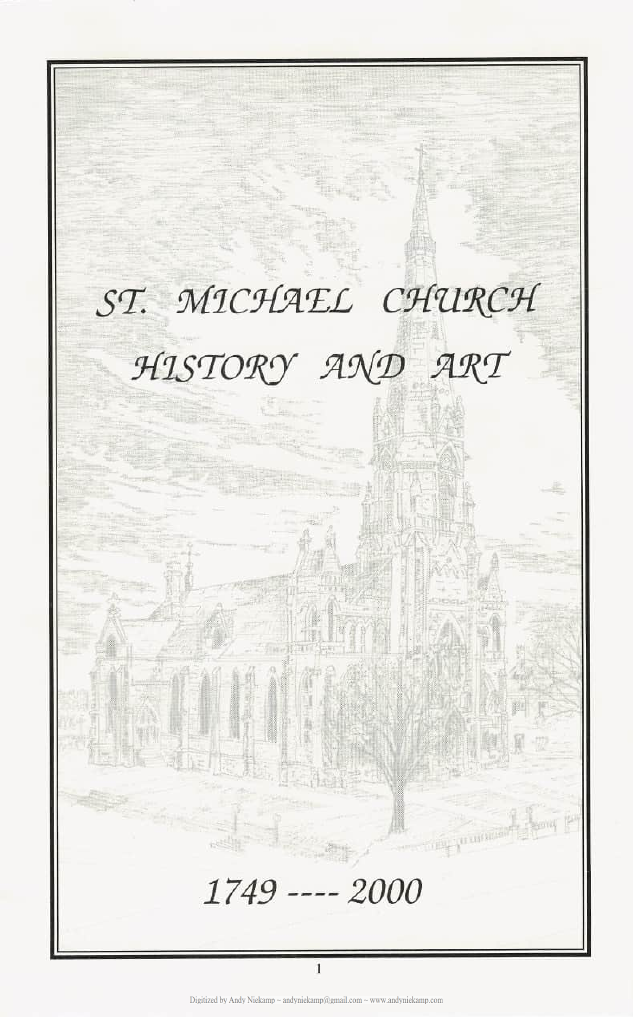
Book compiled by Mary Lou Bornhorst & Virginia Hoehne. Page 1 sketch by Dr. William Schrimpf. History articles by Margie Wuebker. Jubilee Year 2000.
Introduction
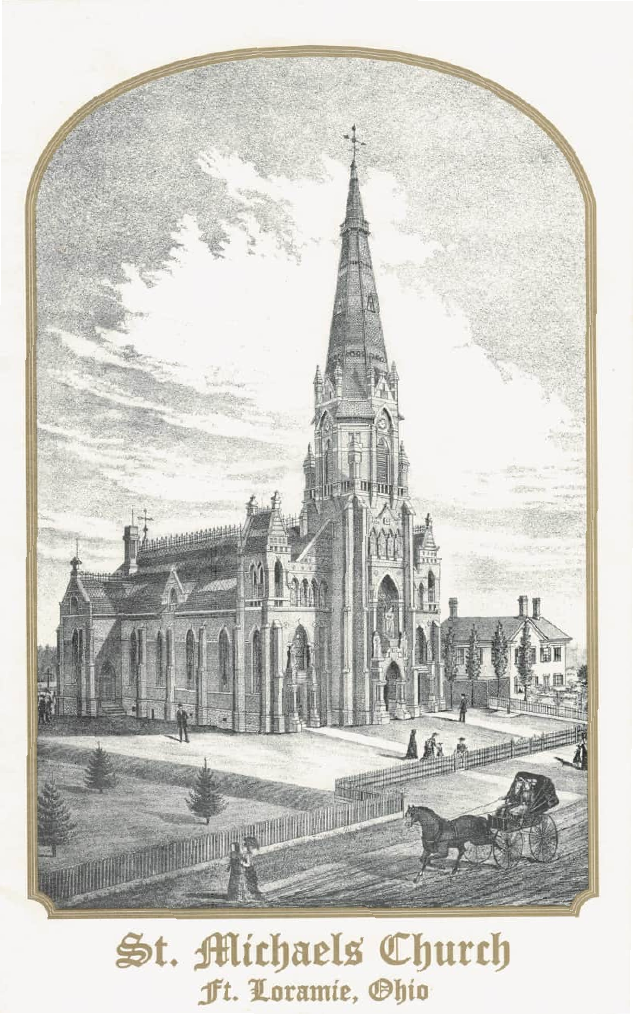
Rising in stately fashion on the western side of Ohio’s central plateau, St. Michael’s Church dominates the Fort Loramie area of Shelby County. Erected more than a hundred years ago, it is a testament to the faith and substance of the predominantly German Catholic pioneers of this area.
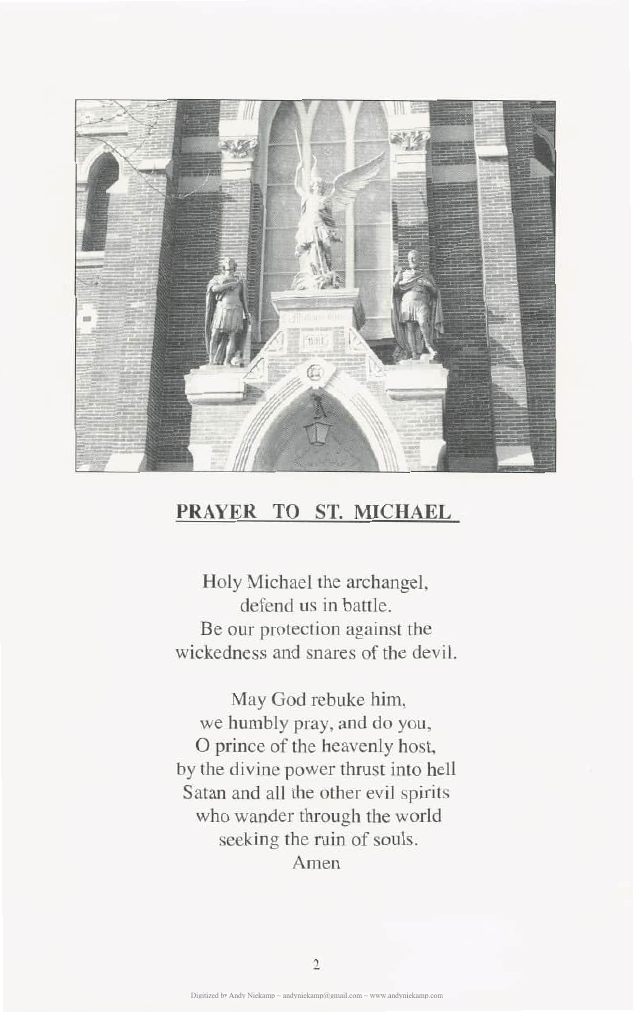
Prayer to St. Michael
Holy Michael the archangel, defend us in battle.
Be our protection against the wickedness and snares of the devil.
May God rebuke him, we humbly pray, and do you, O prince of the heavenly host, by the divine power thrust into hell Satan and all the other evil spirits who wander through the world seeking the ruin of souls. Amen.
Jubilee Year 2000 — Pastor’s Letter
Dear Parishioners and Guests of St. Michael Church:
It is with great pleasure that we present you with this booklet on the history and art of St. Michael’s Church. The Catholic faith in our local community began some 250 years ago with a Mass being celebrated on the Ferd Fleckenstein farm. Since then, with men like Jesuit missionary Pierre Loramie, Fr. Louis Navarron, Fr. August Berger (our first pastor), and Fr. Wilhelm Bigot, the Catholic faith continued to prosper. I am very honored to be a successor of these dedicated priests.
The church not only prospered but numbers of parishioners grew also. From a log cabin, to the first brick church (our present chapel), to its enlargement and finally to the building of the present church, the parishioners of St. Michael Church have always met the needs of their growing faith community. This has not been done with little expense or sacrifice. The Catholic Church is an integral part of the local community and parishioners sacrificed time, talents and treasure to make sure St. Michael’s continues to grow and be their spiritual center. This is most evident in the adornments and art that make our church so very beautiful and so very Catholic.
We encourage you to use this booklet to learn more about the history and art of St. Michael’s Church. We continue to be a faith-filled community, responding to God’s call to holiness, as we celebrate the great Jubilee Year 2000.
Sincerely yours in Christ,
Rev. Steven L. Shoup, Pastor
History of St. Michael Church
By Margie Wuebker
St. Michael’s Catholic Church continues to be the spiritual center for more than 940 families today as it has been in the past. It is the place where the faithful worship, where babies are brought for baptism, where couples come to exchange wedding vows and where deceased parishioners are carried for a final farewell.
Even when it existed only in the dreams of settlers, the church was a unifying force. The first step came in 1838, when they formed St. Michael’s Church Society at the home of local businessman James M. Pilliod. The Rev. Louis Navarron offered the first Mass in Pilliod’s storeroom. In later years, the faithful worshipped at a log house, where W. H. Quinlin formerly operated a drug store.
By 1849, the parish had grown to 100 families and the need for a new church was clearly evident. Later that year, workmen began laying the foundation for a structure that would measure 30 feet wide and 60 feet long. A cholera epidemic that claimed 28 lives in a two-month period delayed the completion until 1851. The first church, which is now used as the chapel at the northeast corner of the present-day church, was starkly plain with a tower and a belfry containing two bells. The congregation quickly outgrew the brick structure and the building was lengthened by 20 feet. A high altar was installed and the addition included a large sacristy, where the priest vested for Mass and children received catechism lessons during the winter.
On January 20, 1874, Archbishop John B. Purcell assigned the Rev. William Bigot as pastor. “In Berlin (as Fort Loramie was called in those days), you will find much work to do: a large parish and there you must build a new church.”
With the church and the choir loft packed to capacity on Sundays and Holy Days, the congregation agreed a larger structure was needed. Parishioners launched a subscription drive with donations totaling $30,000.
In his writings titled “Annals of St. Michael’s Parish,” Bigot noted parishioners favored construction of a barn-like structure. He envisioned one with three aisles like Gothic style St. Joseph’s Catholic Cathedral he had visited in Cleveland.
Architects from the Cleveland-based firm of Cudell and Richardson estimated the project would cost more than $40,000 without decorations. The parish was to furnish sand and lime as well as all the lumber and nails needed to erect the scaffolding. The lumber was to be of the best quality Norwegian pine. Parishioners were also responsible for seeing that the sand was adequately sifted before being added to the mortar.
Foundation stone came up the Miami and Erie Canal from Piqua, with farmers unloading the heavily-laden boats. The cornerstone for the 170' by 64' church was laid October 11, 1879.
Anton Gohr of Minster supervised the entire construction while local merchant Henry Quatman was commissioned to make more than one million bricks and deliver them to the site. The bricks for the exterior of the church and the interior of the belfry were to be stained with Venetian red and oil, giving a rich red color when burned in a wood-fired kiln.
Bishop W. H. Elder came to Fort Loramie to consecrate the new church due to the illness of Archbishop John Purcell. This was considered quite an honor, since only three or four churches in the archdiocese had been accorded such recognition. St. Michael’s, the ninth oldest of 260 parishes in the archdiocese, met all five requirements for consecration.
Forty parishioners on horseback greeted Elder’s coach that autumn day, with some 4,000 people lining the village streets. Bells chimed from the 200-foot church tower and cannons boomed. The bishop brought sacred relics for the new altar and adoration rites continued through the night. Clergy from the surrounding area and thousands of friends and relatives attended the four-hour consecration Mass, which began at 6 a.m. Festivities continued until the last visitor headed for home after midnight.
The ceremony and pageantry was recreated in November 1981, when Archbishop Joseph Bernardin came to mark the centennial anniversary of the dedication of the church.
Many interior and exterior improvements have been made over the years, among them adaptations mandated by the Second Vatican Council. The altar of sacrifice and the pulpit became the focus of the sanctuary with a new altar constructed so the priest could face the people. The $195,000 refurbishing project in 1987 also included painting of the interior, carpeting the floors and installing recessed lighting. In 1988, the new altar was dedicated and the pulpit was blessed during a Sesquicentennial Mass marking the 150th anniversary of the founding of the parish.
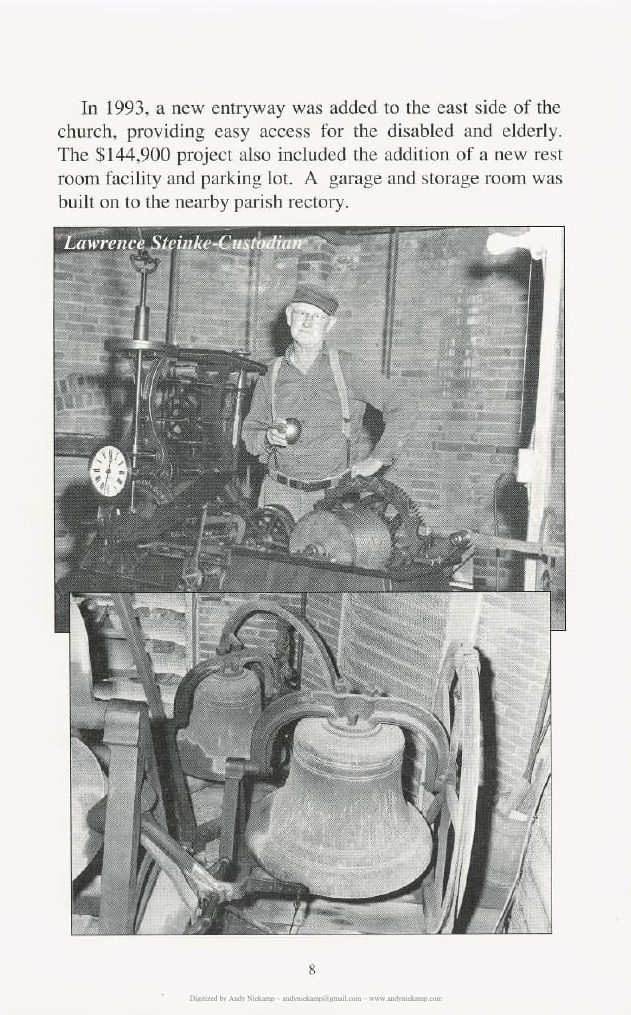
In 1993, a new entryway was added to the east side of the church, providing easy access for the disabled and elderly. The $144,900 project also included a new rest room facility and parking lot. A garage and storage room was built onto the nearby parish rectory.
Story of the Bells
By Margie Wuebker
The Rev. William Bigot and members of St. Michael’s unknowingly paved the way for a larger church with the purchase of not one but four bells.
In February 1878, news of the death of Pope Pius IX reached Fort Loramie. The bells were tolled three times a day for nine days to mark his passing. Mass servers were assigned to the task and Bigot writes that they did the job a little too well — the bell cracked.
The discordant sound convinced the congregation a new bell was needed. The collection yielded $800, more than enough to buy a bell. The St. Ann Sodality decided the church needed a second bell and then school children rallied to the cause, collecting money to purchase a third.
They arrived by canal boat from the Cincinnati firm of Vanduzen and Tift. The largest, weighing 1,800 pounds, was to be called St. Michael. The second, weighing 1,200 pounds, would be Maria and the 500-pound one was to become John Leo.
Bigot blessed the bells on the feast of St. Peter and Paul. The people quickly noticed the bells did not sound as loud in the tower as they had on the ground. “I decided they should have one that rumbled,” Bigot wrote. He ordered a 3,600-pound bell to harmonize with the others. It would be called Wilhelm because he had donated a year’s salary for the purchase.
Men on the canal boat rang the bell miles before Fort Loramie came into view. People heard it far and wide and came to help with the unloading. It was transported to the church on a sled pulled by four horses. However, it proved to be much too big for the existing tower. Even a temporary 40-foot tower built by Anton Gohr did little to improve the sound. A new church with a high tower became the solution.
1878–1881 Contractor’s Specifications
Cudell & Richardson, Architects of Cleveland — architects for St. Joseph’s Church in Cleveland — were recommended by Fr. P. Guardian.
Size: length 170', width 64', with three naves. The center vault 55' high, the side vaults 32' high and the tower 200' high. Building material — brick, trimmed and decorated with sandstone. The style would be a rich Tuscan-Gothic. Bare brickwork without windows and decorations was not to cost more than $45,000, the congregation burning their own brick and hauling stone and sand.
In August 1879 they prepared for construction. Foundation stone was furnished by Stadler of Piqua. Farmers delivered the stone from canal boats on the Miami & Erie Canal. Southerland & Company, noted bridge builders, had the contract for the foundation and ground floor, to be finished by October 1. The cornerstone was laid Sunday, October 11.
Anton Gohr of Minster supervised the entire construction. Henry Quatman agreed to deliver 1,080,000 bricks at $4.50 per thousand. John Deman of Defiance did the masonry at $3.50 per thousand. Worthington of Berea Sandstone near Cleveland delivered 8,000 cubic feet of sandstone at 16 cents per cubic foot — the same firm that furnished sandstone for the Shelby County Court House. John Bayer & Company set the stone. Sanflect of Toledo furnished labor and material for carpentry of vaults, roof and tower. Sand and lime came from Sidney, Piqua, and Loramie Creek. Mr. Hayes of Sidney did the plastering. John D. Inderrieden of Fort Loramie laid the foundation and remodeled the existing church.
Booth & Riester of Buffalo furnished twenty-two windows, most with life-size figures. Mr. Hefele of Cincinnati did the fresco work. Mr. Schroder furnished the high altar, side altars, chancel and communion rail, the statue of Jesus and the archangels and confessionals. Eighteen statues and fourteen stations of the cross came from Fustet (Pustet), Munich, through a Cincinnati firm. Schafer of Milwaukee furnished the organ with twenty-two registers. A Delphos firm furnished pews to seat eight hundred.
The church was dedicated October 1, 1881.
Cost Breakdown
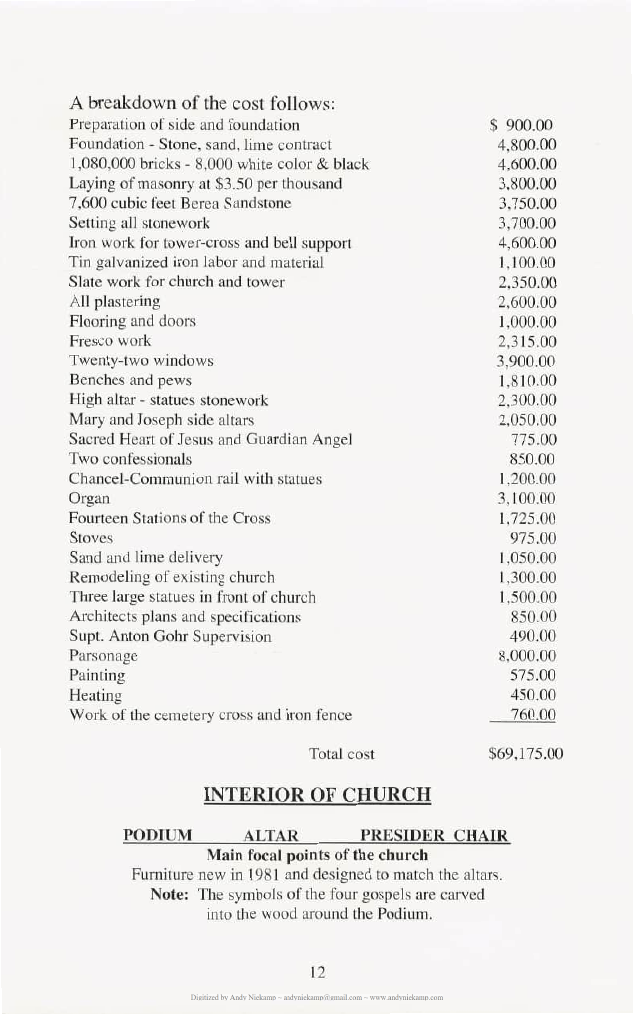
| Preparation of site and foundation | $900.00 |
| Foundation — stone, sand, lime contract | $4,800.00 |
| 1,080,000 bricks | $4,600.00 |
| Laying of masonry | $3,800.00 |
| 7,600 cubic feet Berea sandstone | $3,750.00 |
| Setting all stonework | $3,700.00 |
| Iron work for tower-cross and bell support | $4,600.00 |
| Tin galvanized iron | $1,100.00 |
| Slate work for church and tower | $2,350.00 |
| All plastering | $2,600.00 |
| Flooring and doors | $1,000.00 |
| Fresco work | $2,315.00 |
| Twenty-two windows | $3,900.00 |
| Benches and pews | $1,810.00 |
| High altar — statues stonework | $2,300.00 |
| Mary and Joseph side altars | $2,050.00 |
| Sacred Heart of Jesus and Guardian Angel | $775.00 |
| Two confessionals | $850.00 |
| Chancel-communion rail with statues | $1,200.00 |
| Organ | $3,100.00 |
| Fourteen Stations of the Cross | $1,725.00 |
| Stoves | $975.00 |
| Sand and lime delivery | $1,050.00 |
| Remodeling of existing church | $1,300.00 |
| Three large statues in front of church | $1,500.00 |
| Architects’ plans | $850.00 |
| Supt. Anton Gohr supervision | $490.00 |
| Parsonage | $8,000.00 |
| Painting | $575.00 |
| Heating | $450.00 |
| Cemetery cross and iron fence | $760.00 |
| Total cost | $69,175.00 |
Interior of the Church
Podium, altar, and presider’s chair are the main focal points. Furniture new in 1981 was designed to match the altars. The symbols of the four Gospels are carved into the wood around the podium.
The baptismal font stands in front of the center altar. Chi Rho, the symbol for Christ, appears on the sanctuary walls. Crosses on pillars and side walls signify that the church has been consecrated and has met all of the requirements.
Windows of St. Michael Church
Booth and Riester of Buffalo furnished the windows. Begin the tour in the back left — up to the center — around to the back.
St. Catherine of Alexandria, 310 AD
Donated by Catherine Hummer Merz. Came from a noble family; converted by a vision of Our Lady and the Holy Child; rebuked the Roman emperor; tortured on a wheel and beheaded.
St. Elizabeth of Hungary, 1207–1231
Donated by Elizabeth Back, sister of Rev. Bigot. Daughter of the King of Hungary; married at 13; three children; loved for her generosity to the poor. After her husband’s death in the Crusades she was driven from court, later founded a Franciscan convent and hospital. Died at 24. Patron of Catholic charities.
St. Anne with Mary
Donated by St. Anne Sodality. Married to Joachim; patrons of grandparents. Pilgrims visit the shrine of Ste-Anne-de-Beaupré, Canada.
Blessed Virgin Mary — Immaculate Conception
Donated by the Holy Mary Young Ladies Sodality.
St. John Baptizing Jesus
Donated by John H. Willman, Clemens Hilgefort, and Herman Broering. Son of Zachary and Elizabeth; prepared the way for Jesus; arrested by Herod and beheaded at the request of Salome.
St. Boniface, d. 755 — Apostle of Germany
Donated by Heinrich Barhorst and family. Born in England; made bishop to Germany by Pope Gregory; founded monasteries; killed by pagans at age 75.
St. Michael — Patron of the Church
Donated by Heinrich Schluter, Sr. and Heinrich Hoelscher. Archangel; leader of God’s powers against Satan; patron of the Church and policemen.
St. Augustine, 354–430
Donated by Justus Wise, Sr. Born in North Africa; baptized by St. Ambrose; Bishop of Hippo; one of the Church’s greatest theologians.
Child Jesus
Donated by the Child Jesus Sodality — 300 children members.
St. Lawrence
Donated by the St. Lawrence Young Men’s Sodality. Assistant to Pope Sixtus II; presented the poor as the wealth of the Church; roasted over a slow fire; patron of cooks and protection against fires.
St. Anthony of Padua, b. 1195
Donated by Francisca Ronnebaum. Franciscan preacher; often shown holding the Child Jesus; invoked to find lost objects.
St. Henry, b. 973
Donated by George Heinrich Eilerman and family. Emperor of the Holy Roman Empire; called “the most Christian prince.”
Rear of the church: Guardian Angel (Margarete Quatman, widow) and Sacred Heart (Rev. William Bigot). Outside front: the four Evangelists — Luke (winged ox), Mark (winged lion), John (eagle), Matthew (angel). Outside center: St. Martin, St. Michael, and St. Maurice — ordered by Rev. Bigot in 1891 from pictures in a Paris magazine for $1,500 while on sabbatical.
The 14 stations were purchased from Pustet in Munich and delivered through their Cincinnati branch. The wood frames were built in the United States.
Statues and Altars
Pustet in Munich furnished the statues: St. Aloysius, St. Joseph, St. Francis Xavier, St. Paul, St. John, St. Peter, St. Teresa of Avila, Blessed Virgin Mary, St. Rose of Lima, and St. Ursula with relics under the altar.
Blessed Virgin Altar
Altar donated by Bernard Pille. A small wooden box left of the altar retains the blessed oils. St. Ursula (4th century) is under the BVM altar — patron of school teachers. St. Rose of Lima, first canonized saint of the Americas, is patron of gardeners. St. Teresa of Avila (1515) founded 35 Carmelite convents.
Center Altar
Relics of St. Laetus, St. Prosperus and St. Reparata are imbedded in the high altar. Figures include St. Peter, Blessed Virgin Mary, Jesus on the Cross, St. John the Apostle, and St. Paul.
St. Joseph Altar
The tabernacle has been moved from the center altar to the St. Joseph Altar. Statues of St. Francis Xavier, St. Joseph (patron of carpenters), and St. Aloysius (patron of youth).
Historical Highlights
1749 — First Mass September 13 to 20, offered by Father Joseph Peter Bonnecamps on the Ferd Fleckenstein farm.
1769–1782 — Jesuit missionary Pierre (Peter) Loramie worked in the area. In 1872 a solid silver cross was unearthed with the removal of a tree at the site of the original Loramie store and station — nine inches long and six inches wide.
1838 — “This parish, named St. Michael’s was established in the year 1838, July 4.” Fifty families.
1838–1848 — Mass celebrated by Rev. Louis Navarron in the home of James Pilliod. Navarron was in charge of the territory from Greenville to Lima.
1849–1851 — First brick church 60' × 30' built (present chapel). One hundred families served by Precious Blood missionary priests.
1851–1858 — First resident pastor, Rev. August Berger.
1864–1874 — First church increased by 20' and a high altar added.
1879–1881 — New church built. Rev. Wilhelm Bigot, pastor. Pipe organ installed; originally hand-pumped. More pipes added 1910; electric motor 1921; over 1,100 pipes by 1985, then electrified so the console could move forward in the choir loft.
1891 — Father Bigot added statues of St. Michael, St. Martin, and St. Maurice to the façade for $1,500.
1920–1926 — First renovation; steeple cross gilded by DeCurtains of Lima. After World War I, German was no longer used in sermons, bulletins, and reports.
1939 — Church receives a face lift. Louis Seger, contractor.
1954–1960 — Renovation; decorative wood removed from the arches; basement enlarged; steel beams and iron posts to reinforce a sagging floor.
1960–1966 — Latin Mass replaced with English. Temporary altar facing the people. Bells and clock electrified.
1971–1980 — Chapel opened for weekday use, then renovated and furnished; tabernacle and hanging votive moved to the side altar.
1980–1991 — Church renovated for Vatican II while keeping historic value; organ renovated; lighting upgraded; new west entrance and handicap-accessible east entry.
1994–1995 — St. Patrick parish joins St. Michael parish.
1991–1999 — East entrance completed; new rectory garage, sidewalks, handicap parking; face lift of the front of the church.
2000 — Marian garden constructed between rectory and church for Jubilee 2000. The statue of Mary was formerly at St. Patrick’s.
Renewal Prayer for the New Millennium
Gracious God, we are your people embraced by your love. We thank you for your presence with us throughout all time. As we celebrate the 2000 years since the birth of Jesus… Create us anew. Liberate us from that which keeps us from you. Enable us to recreate our world and restore justice. Heal us from every form of sin and violence. Transform us to live your Word more profoundly. Reconcile us so enemies become friends. Awaken us to the sacred; nurture our relationships; enliven our Parishes; reunite our families. Fill us with joy to celebrate the fullness of life. Empower us to be a community of love growing in your likeness. Amen.
Permission was given for material from History of Shelby County Ohio (Shelby County Historical Society); Annals of St. Michael’s Parish by Rev. Wilhelm P. Bigot; and Early History of Ft. Loramie (Ft. Loramie Historical Association). Thanks to Margie Wuebker, Dr. William Schrimpf, Alfred Boerger, Joseph Borchers, Emma Nutt, Victoria Albers, and Frances Rethman.
Original Pages
All 36 pages are in images/St-Michaels-Church-Ft-Loramie-Ohio/ as page-01.png through page-36.png.