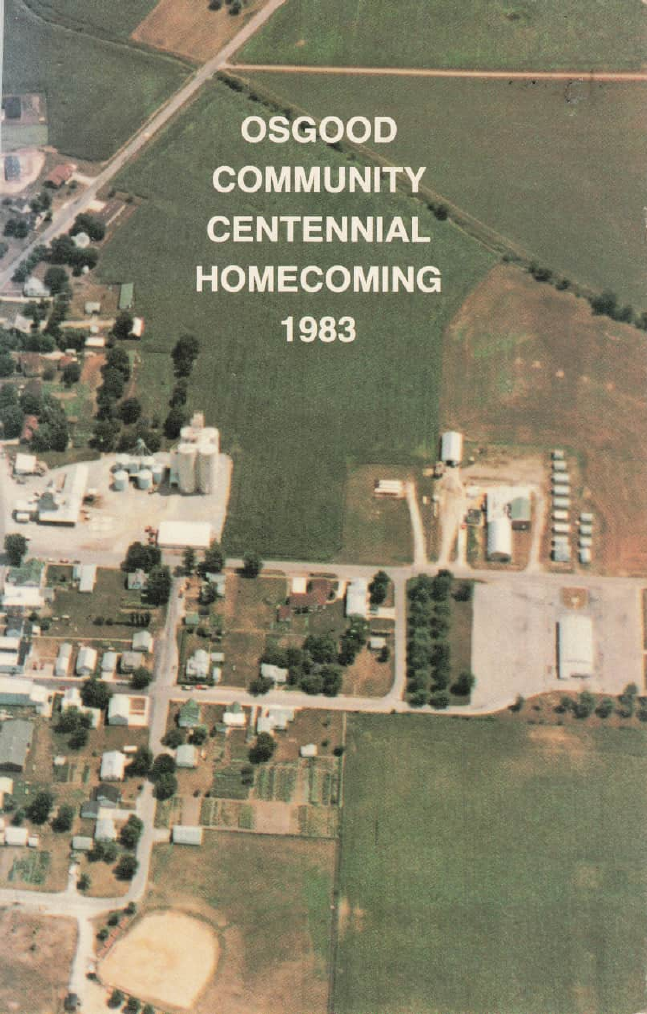
1983 Homecoming Committee
General chairlady: Shirley Wenning
Co-chairmen: Nick Wenning, Urban Winner, Louis Alexander
Historical: Alice Poeppelman
Co-chairladies: Verene Kramer, Janice Berger, Mary Ann Arling, Rita Pohl, Diana Albers, Theckla Recker, Alvina Kuether
Chicken barbecue and concessions — American Legion Post #588. Candy and pop stand — Youth Organization. Children’s activities — Mary Ann Arling, Linda Arling; co-chairs Norma Bohman, Donna Grieshop, Vernon and Sharon Mescher. Teenage and adult activities — John Seger. Miniature tractor pull — Gary Poeppelman, Harold Bohman. Entertainment — Elmer Wietholter. Chance games — Louis Alexander, Ohmer Brandewie.
Early Village History
Located in the northeast corner of Darke County, in Patterson Township, Osgood is an incorporated town with a population of 318 (1983). Legend has it that a Captain Osgood moved through the area in the late 1870s, a Civil War captain from Versailles, and the town took his name.
Patterson Township was incorporated in 1841. The Winger family plotted the southwest section. John Henry Winger, born in 1844, fought in the Civil War and made his home a half mile west of Osgood.
On March 12, 1881, Anne Brewer negotiated the transaction of seventy acres to Osgood; it became a village in 1883. Rachel Brewer and Harvey Frank sold land for the C. H. & D. (Cincinnati, Hamilton and Dayton) railroad on September 5, 1881. Osgood was incorporated August 6, 1883. First officers: H. C. Miller, mayor; T. Mendenhall, treasurer; W. S. Williams, clerk; N. Fry, marshal. Councilmen: H. H. Brown, S. H. Love, George Preston, C. W. Supinger, J. Frantz and Charles Pearson.
Early settlers included Winger, Brewer, Whitaker, Goubeaux, Coble, Schwierking, Dirksen, Schulze, Miller, Mendenhall, Straker, Connaughton, Alexander, Burns and DeWeese.
The Church of God began in the late 1880s and later ceased. A Christian church was founded in 1886 on land donated by Anthony Coble; services overflowed until the mid-1920s, with yearly reunions until 1974. The building later belonged to Alfred Holscher. Families who worshipped there included Hills, Davidsons, Staudts, Millers and Wingers.
A post office opened with Tim Connaughton as first postmaster, followed by Ruehen Hanna, Mary Stueve, Caspar Franzer, Herman Franzer, George Bohman, Irene Bohman, Eileen Pleiman, and Bernard Pleiman (postmaster in 1983).
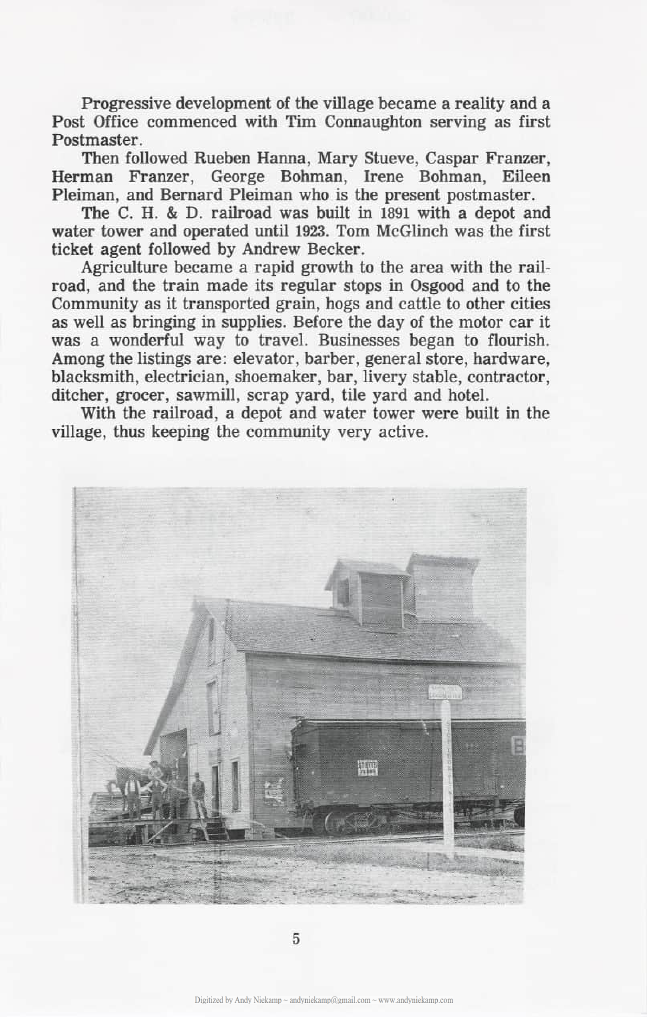
The C. H. & D. was built in 1891 with a depot and water tower and ran until 1923. Tom McGlinch was the first ticket agent, then Andrew Becker. The train hauled grain, hogs and cattle and brought in supplies. Businesses flourished: elevator, barber, general store, hardware, blacksmith, electrician, shoemaker, bar, livery stable, contractor, ditcher, grocer, sawmill, scrap yard, tile yard and hotel.
The depot stood where the Osgood Service station later stood. Across the street was a hotel later bought by Mr. and Mrs. Joseph Alexander. Hilgefords Saloon was near the depot. Alexander Brothers ran a grain elevator. The water tower, several hundred feet north of the depot, was sold in 1923 to Fred J. Poeppelman, who made a circular corn crib of it. The livery stable was east of the elevator. Mendenhalls’ general store later burned.
A cigar factory stood across from the old school; young women of the community worked there. After it closed, Ernest Althoff made it a garage. Clem Gunckle was an early barber. Al Brown owned the coal yard — three to four dollars a ton would heat a house a year. John Beard was the “honey dipper.” William Danzig ran a piano store; platform dances were held on the lawn. Casper and Herman Franzer’s hardware also housed the post office; George Bohman later ran the store.
Businesses of Osgood
Alexander Elevator
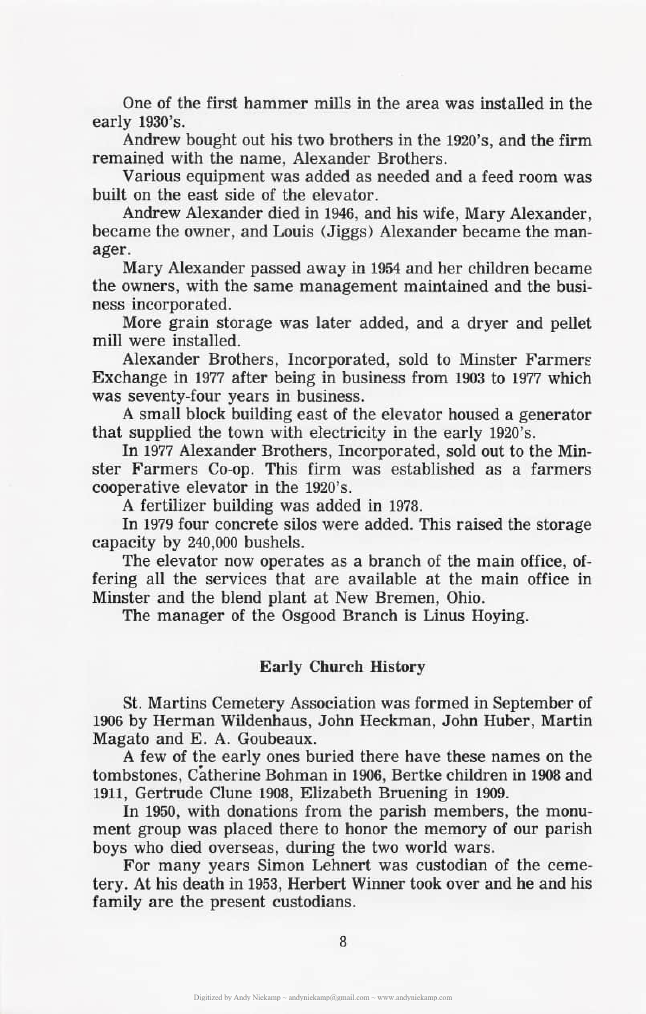
Alexander Brothers began in 1903 — Andrew, Joseph and Elie, with Andrew as manager. They bought an elevator on the present site and another across the street. The high part of the present house was built in 1916. Andrew bought out his brothers in the 1920s. After Andrew died in 1946, Mary Alexander owned the firm and Louis “Jiggs” Alexander managed it. After Mary’s death in 1954 the children incorporated the business. It sold to Minster Farmers Exchange / Co-op in 1977 after seventy-four years. Concrete silos added in 1979 raised storage by 240,000 bushels. Branch manager in 1983: Linus Hoying.
Tuente Livestock
Founded by Ben Tuente in the early 1920s (hogs, coal, fertilizer). In 1928 he bought the Frank Pequignot farm a quarter mile north of town. After Ben’s death in 1946, Elmer managed Osgood; sons Ron and Roger added a St. Sebastian yard and a seven-truck fleet licensed in fourteen states. After Elmer’s death in 1981 they employed 21 people.
Osgood Cement and Tile
In 1906 local men formed The Cement Tile & Block Manufacturing Company. The plant opened in 1908 under Wm. Schwieterman. Cement arrived on the C. H. & D.; sand and stone were shoveled by hand. Sold to Albert Magoteaux in 1925; Ralph joined after World War II. Blocks gave way to septic tanks in 1946; feed bunks in 1967. Ralph ran it until 1981.
Hardware
The present hardware building dates from 1903 after a fire. Owners and operators included John and Celia Meyer, Leo Neiberding, William George, Elizabeth Lachey, Ohmer Brandewie and Alphonse Franzer, Bernard and Sylvester Pleiman, William Whipp, John and Marge Langenkamp, Nicholas and Linda Arling, and (1981) Paul and Thomas Gagel as a branch of Gagel Hardware, Maria Stein.
Poeppelman Gas
Fred J., Frank and John Poeppelman began natural gas in 1926 from wells east of town. In 1952 the wells could no longer meet demand and propane was added.
Norb’s Place
Early owners included Wolaver, Lee Hilgefort and Leo Schwieterman. Herman Winner bought it in 1929; later John Schlarman and Bernard Rutschilling. Norbert Stucke bought it in 1946; after his stroke and death, son Roman ran it and purchased the business in 1964.
Winner’s Incorporated
Robert Winner bought William Leeper’s meat market in 1930. A slaughter house and stockyard followed; a locker plant of 300 lockers in 1944. Sons Vernon, Ralph, Urban and Tom bought the firm in 1950; Kenneth joined in 1963. Yards later at Philothea, Willowdell, Greenville and Williamsburg, Indiana. Fifty-three years in the area by 1983.
Other firms
Poeppelman sawmill (1930, Fred J. Poeppelman; burned 1969). L. H. Schmidt Eggs (1934–1982). Lachey’s Economy Store. Ervin Recker feed store (1948, twenty-seven years). Osgood Service body shop (1949; Maurice Brunswick sole owner 1981). Bernadetta’s Beauty Shop (1949, Bernadetta Kemper). Elmer Wietholter scrap yard (1953). Beckman & Gast tomato cannery (Osgood plant, Nick Gast; ~100,000 cases in an eight-week season). Osgood Plumbing (Neal Pleiman, 1963). Moss Dairy Equipment (Frank E. Arling Jr., 1969). Bohman T.V. (1967–1977). Poeppelman Body Shop (Randy Poeppelman, 1981).
Church History
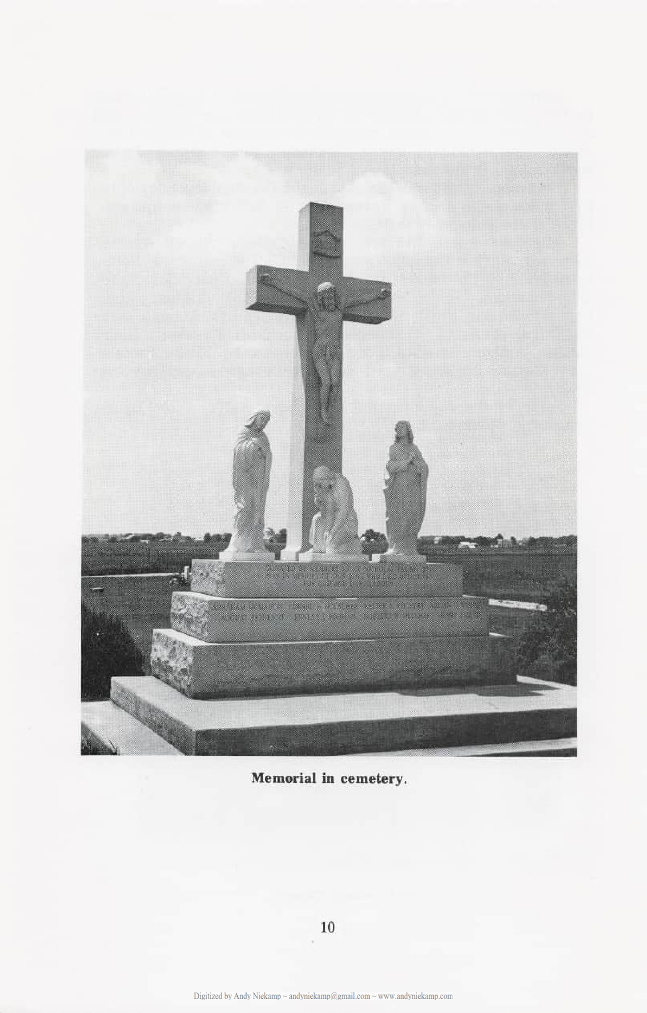
St. Martins Cemetery Association formed in September 1906 (Herman Wildenhaus, John Heckman, John Huber, Martin Magato, E. A. Goubeaux). Early burials include Catherine Bohman (1906) and others through 1909. In 1950 a monument honored parish boys who died overseas in the two world wars. Simon Lehnert was long custodian; Herbert Winner and family followed after 1953.
Saint Nicholas Catholic Church was organized August 12, 1906 by Rev. Bernard Beckmeyer at a cost of $22,000. Building committee: Henry Brandewie, John Heckman, Joseph Alexander, John Bohman, Joseph Bertke, John Bruns, Henry Schemmel. First Mass December 6, 1906, Rev. F. B. Veil celebrant. After the frame church was demolished, volunteers raised a red-brick church. Fr. Paul Golembiewski served ten years from March 1973 until his death in June 1983.
School
Osgood’s first school was demolished in 1912; its bricks lined the public school begun that year. Josephine Franzer began teaching September 1916; Jesse Baker taught the upper grades. They followed Bertha Alexander and John Connaughton. Josephine taught forty-six years — fifty-three pupils in grades one and two one year, eighteen in grade one her last year.
Schools closed one year for smallpox and six weeks another year for the flu. Christmas and Thanksgiving programs, box suppers, and spelling and ciphering contests were community highlights; township winners competed in Darke County.
Banking History
Banking Corporation of Osgood was chartered December 31, 1915 and opened in 1916 at S.R. 705 and 716. First president Henry Brandewie; vice-president Herman Brandewie; chairman Louis J. George. First cashier Leo Wildenhaus. March 7, 1916 report: $40,442.70. August Reichert was cashier 1918–1945; Alga Bruey until April 1973; then Ronald Thobe.
March 21, 1927: two heavily armed masked bandits robbed the bank in daylight and escaped with two thousand dollars.
A new bank on S.R. 705 opened Sunday, June 24, 1962, on land purchased from Charles Winger. In 1983 directors included Louis Alexander (chairman), Alga Bruey (president), Robert Simon (vice president), with eight full-time and two part-time employees. Interest on savings in 1945 was one percent.
World Wars, Flood, Depression
World War I veterans from the community who gave their lives: Abraham McMahon and August Piquenot. World War II: Edward Holscher, Ernest Bohman, Walter Reichert, Norbert Mescher, Adrian Wissman and Henry Zenz.
Spring 1913: rain and melting snow overwhelmed Mile Creek and flooded thousands of acres for a few days.
Depression, 1929–1934: wheat 38 cents a bushel, hogs $2.90 a hundred, oats 12 cents — a bushel of oats bought a pound of Mother’s Oats; two bananas for a nickel. Land $80 an acre; a two-plow tractor $600; a Model T $495; milk $1 a hundred; a dance 25 cents and the girl got in free. Families butchered, canned and baked at home; some sold home-brewed whiskey to make ends meet.
Fire Department and Rescue
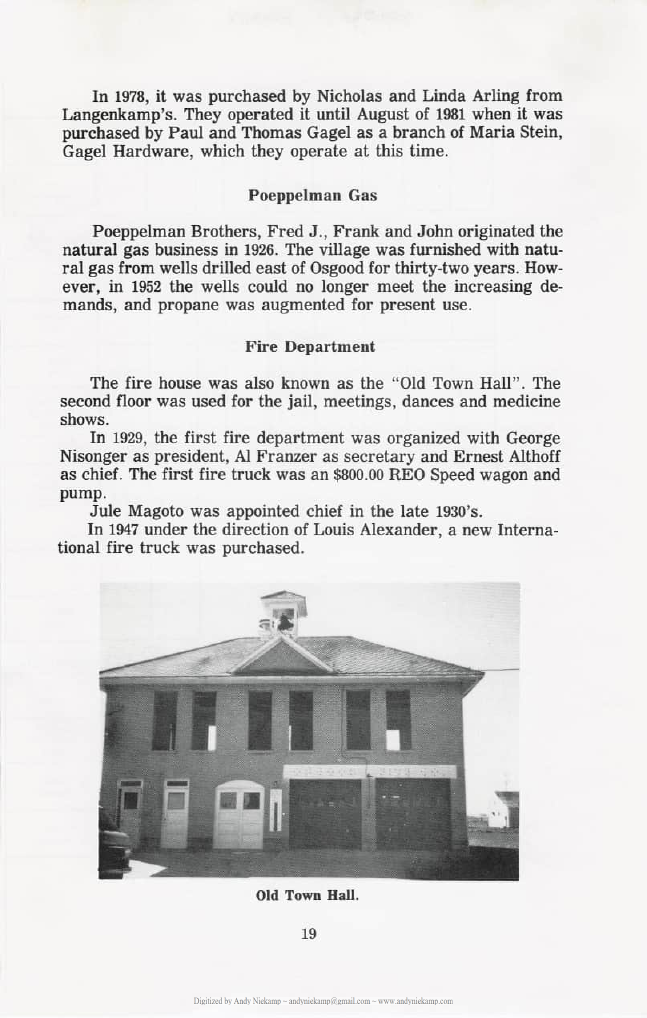
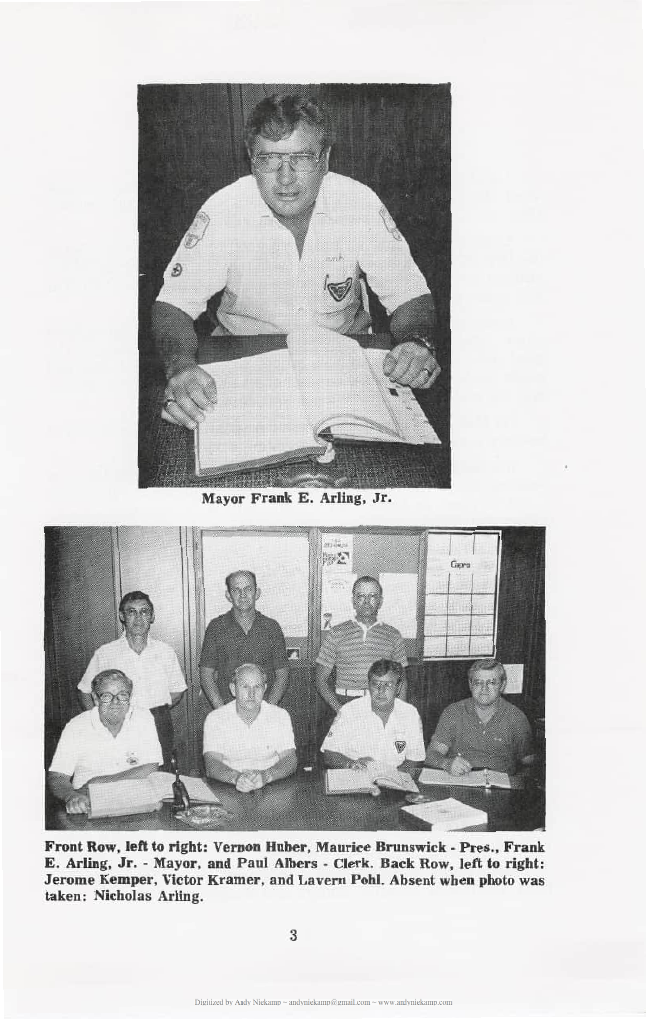
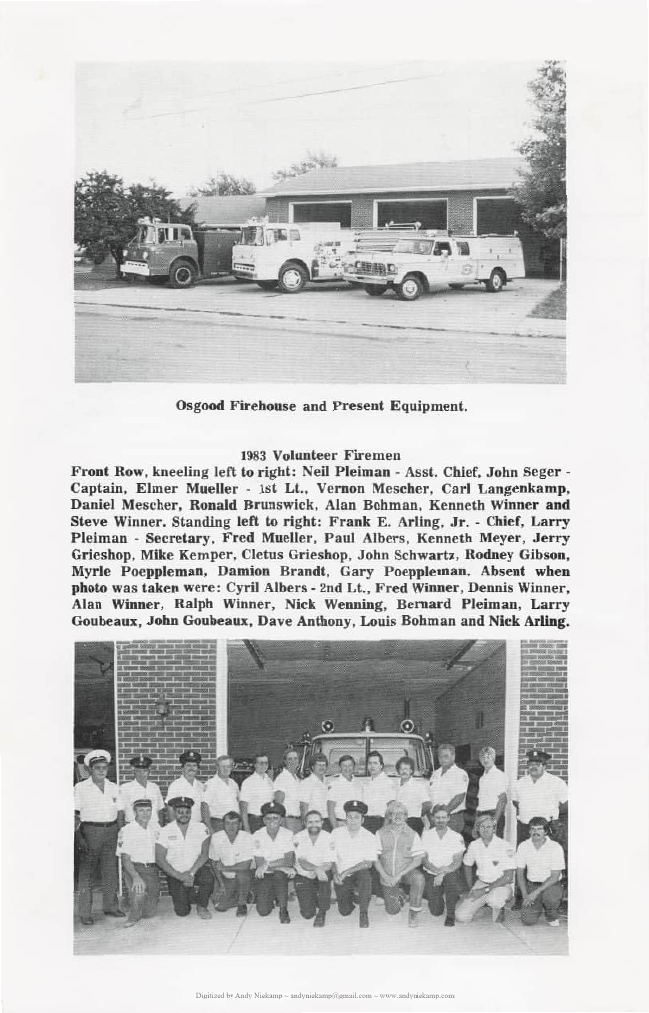
The fire house was the old town hall; the second floor held jail, meetings, dances and medicine shows. First department organized 1929: George Nisonger president, Al Franzer secretary, Ernest Althoff chief. First truck: an $800 REO Speed Wagon. Jule Magoto became chief in the late 1930s. A new International was bought in 1947 under Louis Alexander. Ralph Magoteaux was chief 1952–1978 (750-gpm pumper 1965; water truck; three-bay brick house). Frank Arling, Jr., took office in 1978; a 4WD initial-attack truck won first place at Mechanicsburg. First woman firefighter, 1981. Rescue squad formed 1975 with Versailles Life Squad; independent since 1980 with a 1980 ambulance and 32 members.
Storms and Floods
November 25, 1950: snow with five- to six-foot drifts. Osgood lost electricity when a transformer blew at the church. Tractors with blades opened roads for Forty Hours Devotion. A daughter was born to Mr. and Mrs. Henry Pleiman with a neighbor’s help.
January 26, 1978: “worst blizzard in over 100 years.” Wind chill 58° below zero. Power out 31–34 hours; town isolated 3½ days. Snowmobiles carried people, groceries, fuel and medicine. Three babies arrived: Susan Elaine Heitkamp at 3:26 p.m. Thursday (John Seger on a snowmobile, nurse Ruth Oldiges, Dr. Blickenstaff by phone); a Speelman boy two days later; Mercedes Maria Core at Wayne Hospital after a state plow and the rescue squad. Victor Hoelscher led the Schwartz family across fields toward heat; they became lost and were taken in by the Grieshops. St. Nicholas cancelled weekend Mass for the first time anyone remembered. No deaths. “No lights, some heat, three new babies, and lots of love and concern for our fellowman.”
June 1, 1980: 3½ to 4 inches of rain. Streets closed; the ball field under two feet of water; children swam and floated on inner tubes. Water receded in a few days.
Park, Bicentennial, Religion, Elders
A recreation committee formed in summer 1971. Labor Day tournament proceeds improved the park. New diamond, shelter house and tennis courts (1973), playground equipment, then about seven wooded acres from Richard Bohman (1976) and five acres including the old school from Marion Local (1978). The school was razed; the lot seeded and trees planted.
August 7–8, 1976: America’s 200th birthday in Osgood — over-40 softball, baking contest, races, pony rides, greased pole, clowns, Thunder-Chicken’s hot-air balloon, horseshoes, bingo, greased pig, tug-of-war in the mud, ox roast.
American Legion Post 588 formed 1946 (32 charter members; Alphonse Franzer first commander). Building 1952 on four acres from Henry Brandewie; mortgage burned 1956. Auxiliary 1952. In 1983: 124 Legion members, 80 auxiliary; Bernard Pleiman commander, Mary Bruns president.
Octogenarians named in 1983 include Leonard Bruey (oldest original parishioner) and Lawrence and Rose Rutschilling (oldest married couple), with Rose Dirksen, Lillie Recker, Josephine Franzer and many others listed in the book.
Original Pages
All 40 pages are in images/Osgood-Community-Centennial-Homecoming-1983/ as page-01.png through page-40.png.