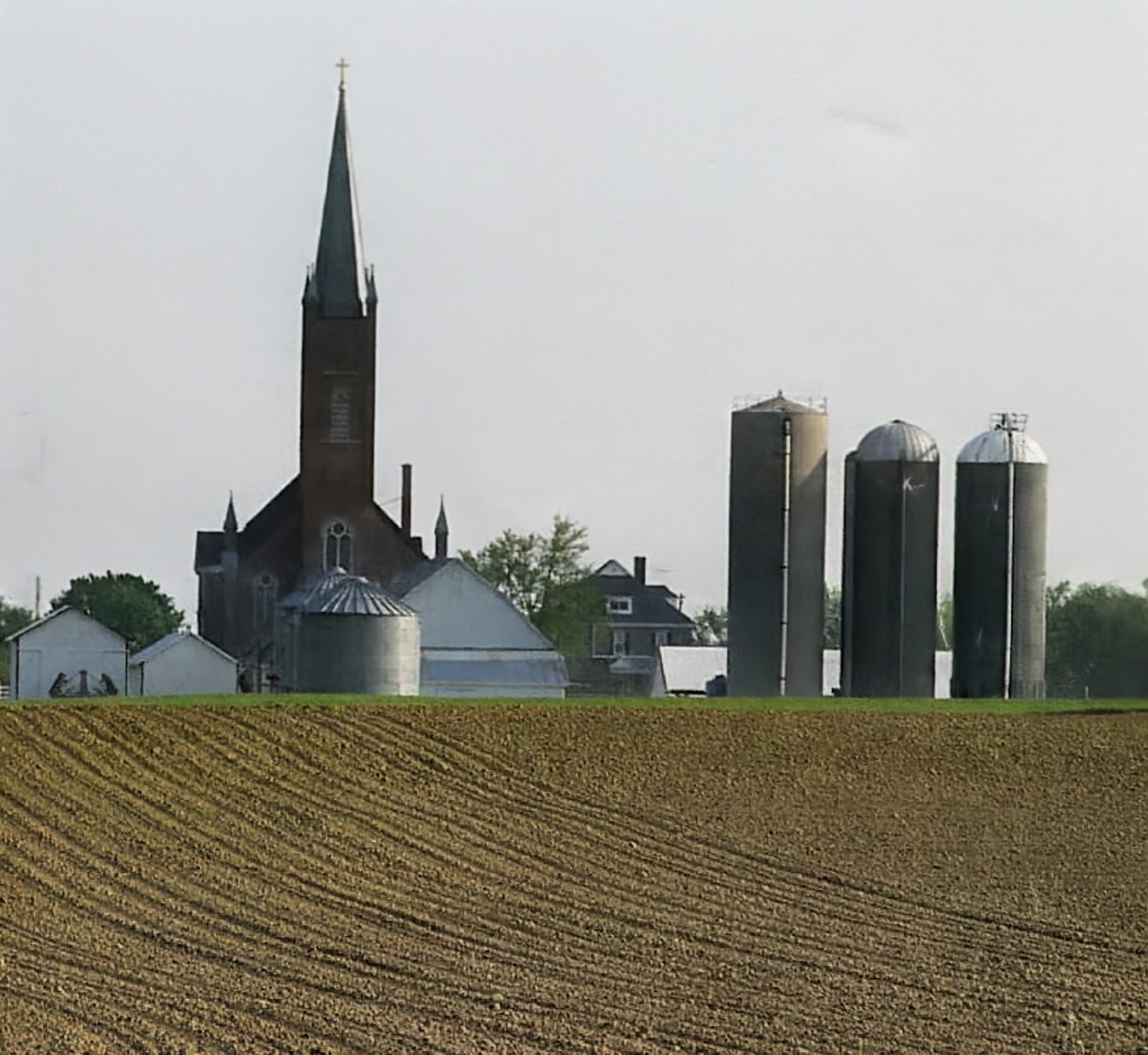
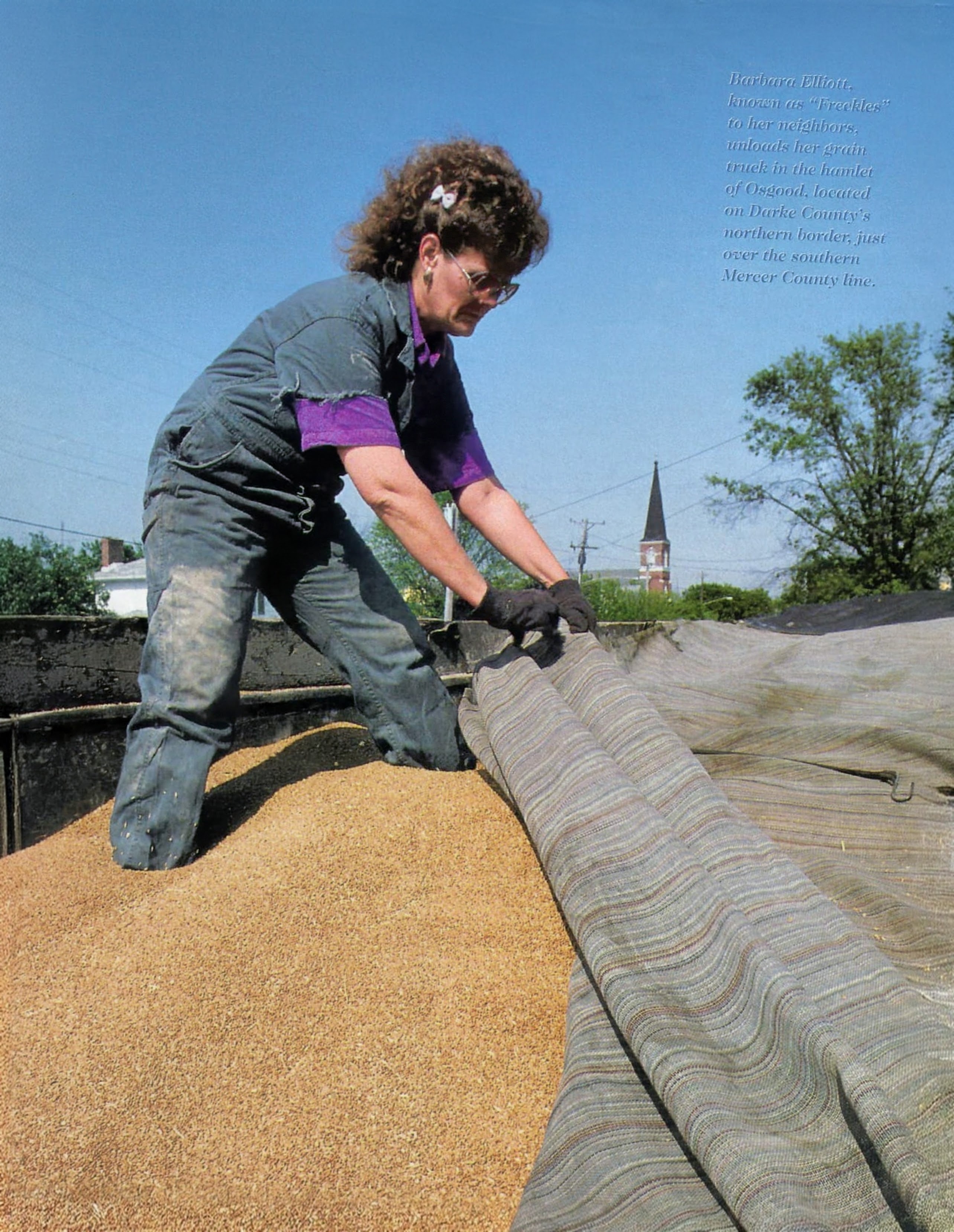
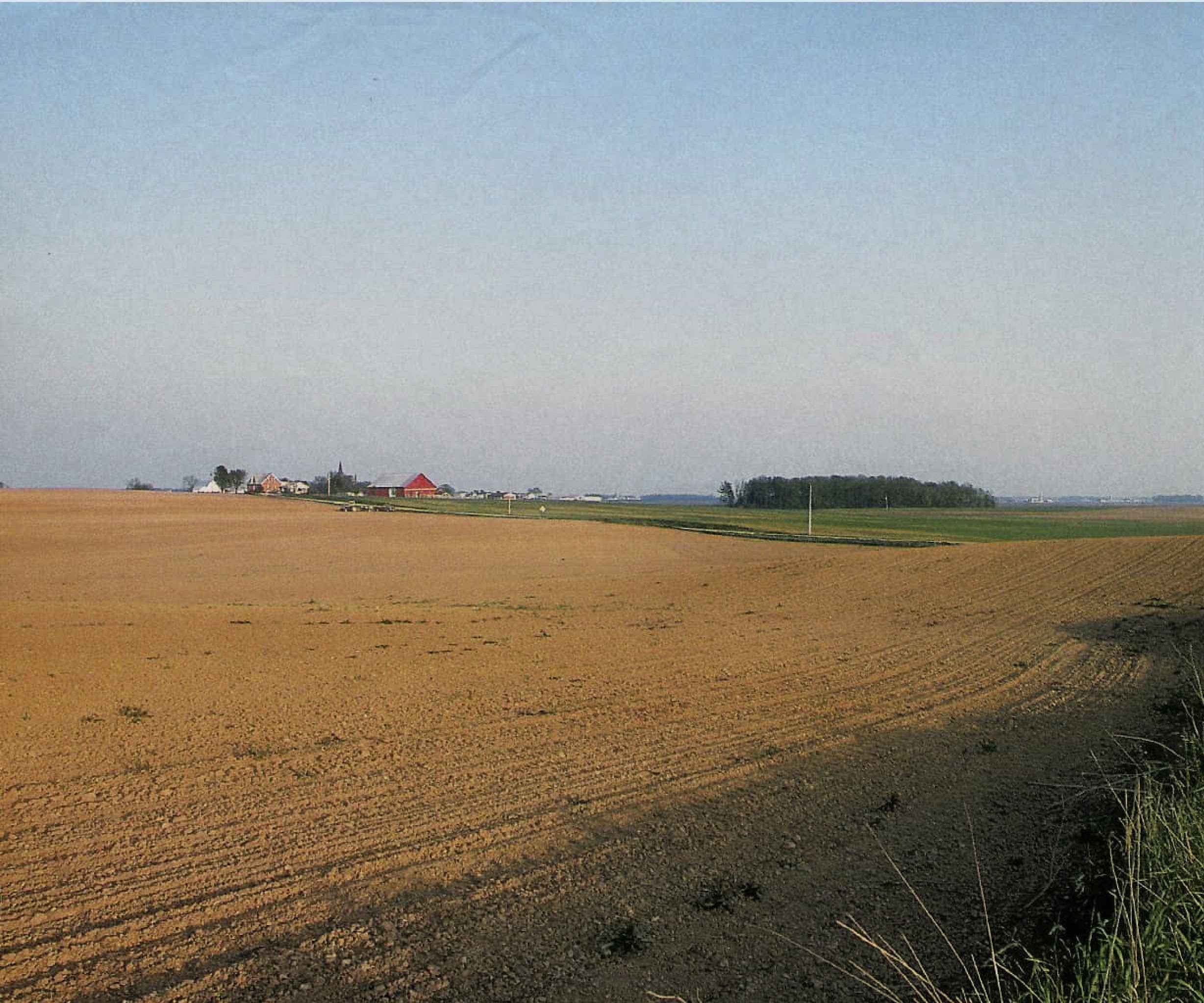
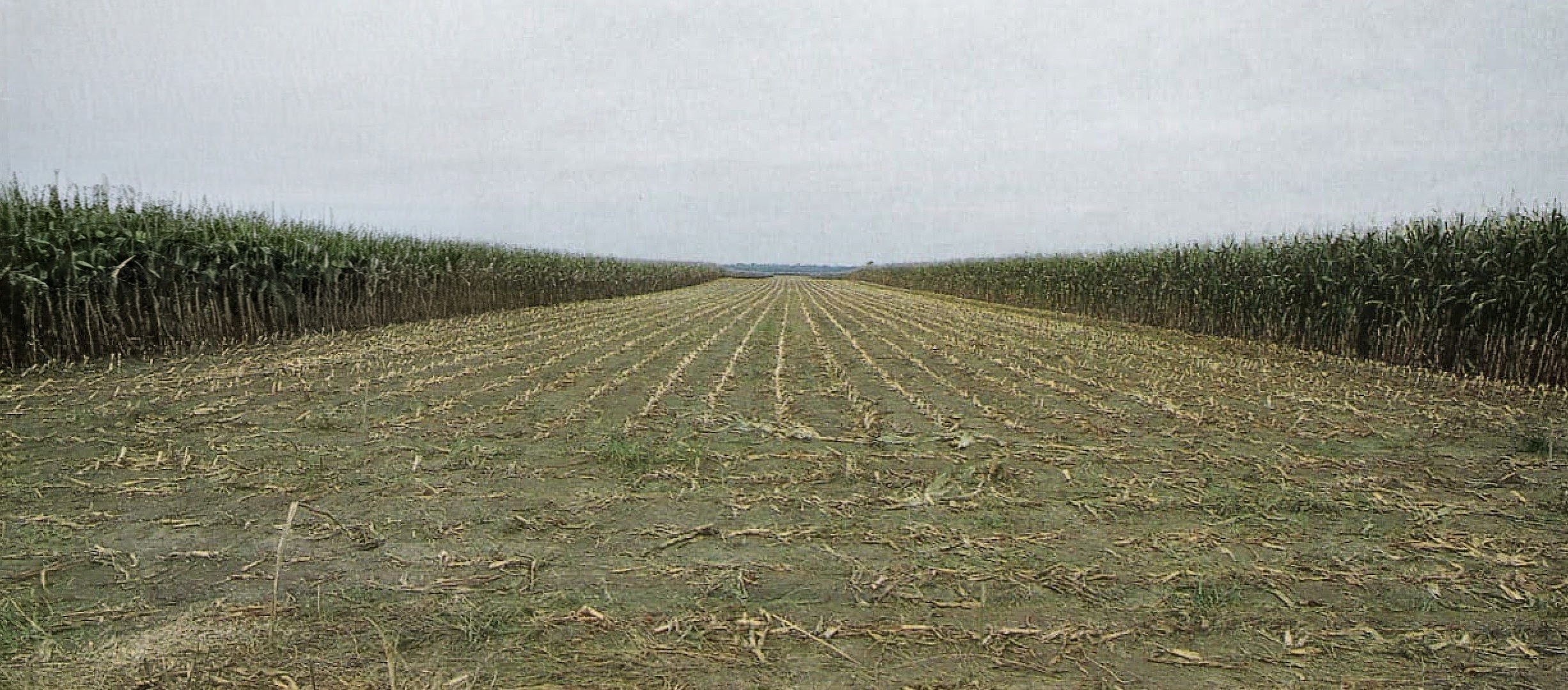
We drove straight up Interstate 75, the original route of the settlers on their way to the auto plants of Detroit. Near Troy, we turned thankfully off, heading northwest, up into some of the richest farmland in Ohio, across terrain so flat you can see into next month. It is country that takes getting used to, so wide and exposed, and in a swathe of southern Mercer and western Auglaize and Shelby counties, it is country relatively unchanged for over a century and a half, ever since it was settled by the hard-headed German immigrants who got off the canal from Cincinnati and began clearing it. Today, a tree in this part of the country is an anomaly, trees being found mostly in the little villages, as though they had been imported. It is a full act of the imagination to see this as all forest, which it once was, part of the great North American hardwood forest. “All the countryside is monotonous in a tree-strewn land,” wrote the pioneer diarist from Mercer, Elisabeth Boeke. “Everything in it lies hidden.”
And before the trees, were hundreds of square miles covered in cranberry bogs, which prepared the way for the great deciduous forest that greeted the stubborn immigrants. The Germans, particularly those from the northern provinces, were not dismayed by either the endless forest or the marsh lands; they were neighbors with the Dutch and understood the agriculture of low-lying areas. Even now, one of the little villages is Cranberry Prairie, just west of U.S. Rte. 127, originally a 1,200-acre peat bog. When the first settlers arrived in 1837, wild cranberries still bloomed in the marshes. The settlers dispatched the thickets of cranberries, and the concomitant rattlesnakes and mosquitoes, and turned the wetlands into farms, although the bogs resisted; some of it wasn’t farmed until the 1950s.
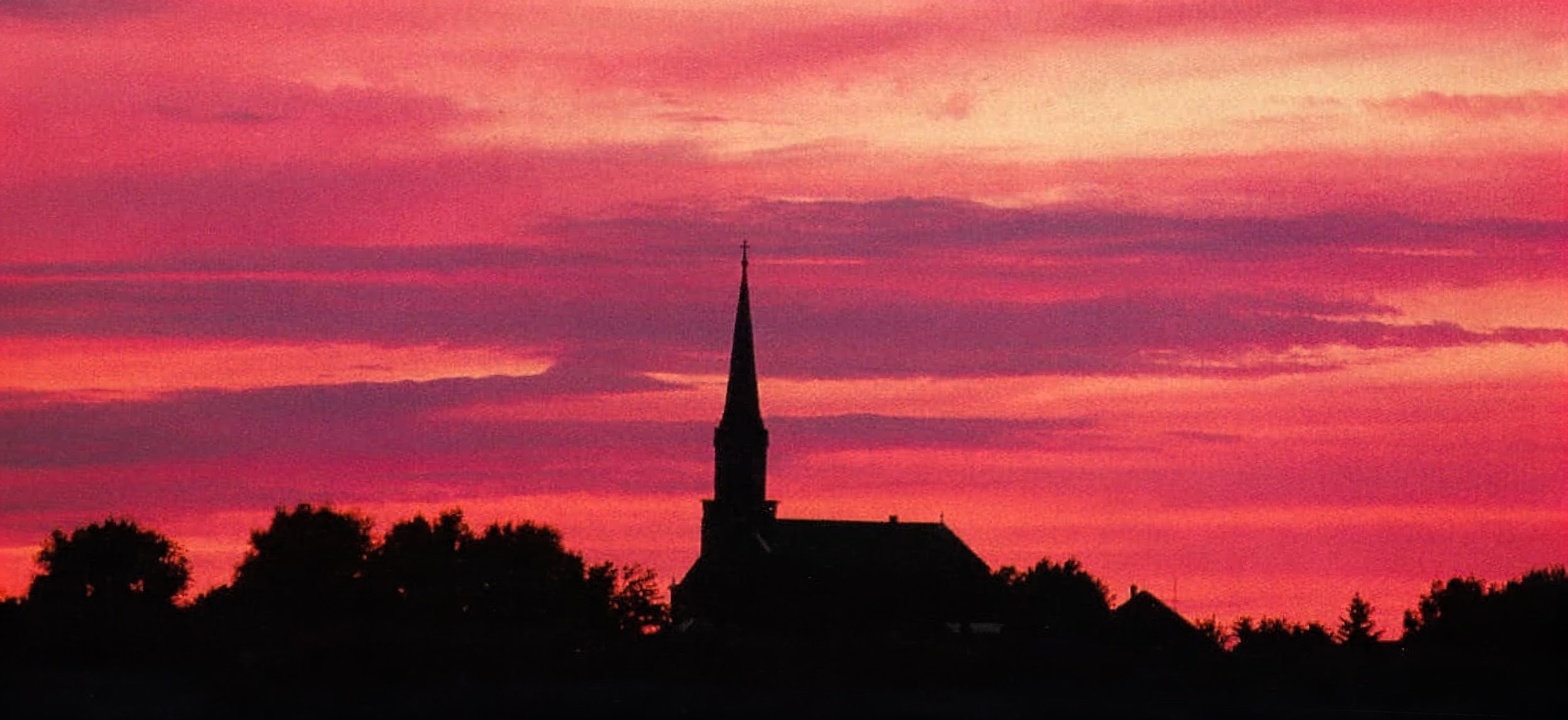
The villages they established then are similar now: two dozen houses, a grocery, a hardware store, maybe a small branch bank and a library, all huddled against an amazing Catholic church of Gothic or Romanesque design with a towering steeple, some of them over a hundred feet high and visible for miles across the flatness. In some places, a half-dozen of them can be seen at once. There are dozens of them, strung magnificently across the prairie, something like an ecclesiastical version of the modern landscape’s utility tower, transmitting the ethereal.
To understand the unchanged consonancy of the country here, it helps to understand that its settlement was no whimsical thrust into the western frontier, but a sophisticated real-estate venture. As my guide, Mary Ann Brown, a native who now lives in Cincinnati where she is director of the Cincinnati Purchase Association, put it, “These were not people stumbling around in the wilderness.” First, they knew that the Shawnees had been pushed west in 1832, the territory was finally relinquished, and that the canal would soon be opened to provide market access. It was also the place that contained the last large portions of available land. The Germans sent scouts up the old Auglaize Trail, and those who came had money for land and the skills to make their way.
Minster became the beachhead for the Catholics, while a few miles north, the German Protestants platted New Bremen. Within two months of the Shawnees leaving, half the land was owned by Germans. The land they got was the land at the summit, the southern tip of the Great Black Swamp. “The sweetest land,” says Ms. Brown. “And they never left.” Ms. Brown’s maiden name is Olding, which is an old Marion Township name, and when she went to Oldenburg, Germany, she kept seeing the German word for “illegitimate.”
“There, in the records, I saw where a woman named Mary Renner married and her husband changed his name. It was because her family owned the land. There, you only use the land, and you protect it. It is an entirely different concept of ownership that amounts almost to feudalism. When they came to Ohio, they gave up their land—they became ‘illegitimate’—which meant they were forfeiting their right to it. ‘Minster, Ohio,’ they wrote.
“Some of that thinking is still in effect here. The little villages here mirror the little villages there. There are windbreakers here the men wear that say ‘Casella Tavern.’ This is the Casella parish, and it is distinct from Maria Stein, which is only four miles away. They see themselves as different, individual. In Mercer County a few years ago, there were thirty-two little parishes like that, enclaves of people transported from Germany whole into these little places; and from their names, I can tell you where they live, on what roads, because they have been in place for five generations. Such an undiluted imprint.”
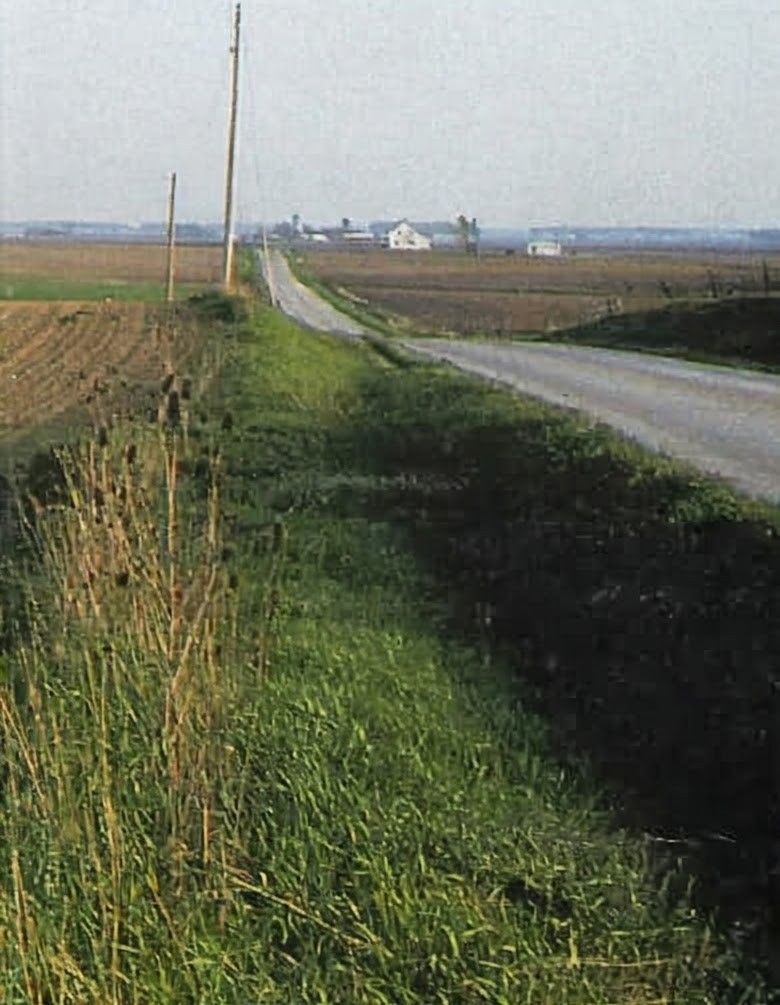
We are heading north now, on the little township roads, and the view is unchanging, the broad sweep of the dark unbounded earth sloping away for miles until the pattern repeats itself at another village that could be the mirror image of the last one, yet distinct unto itself in its tilt upon the horizon. “West, near 127, is where Annie Oakley is from,” says Ms. Brown. “I have a lot of affection for her. When she kept beating men at shooting, they said, ‘Well, she sleeps with Indians, you know.’ It is what they would say when they couldn’t think of anything else to say.”
We head north, on old 66—the Auglaize Trail—the oldest road, which was in turn followed by the canal, the high-ground template for all transportation to follow. On this trail, Mad Anthony Wayne built one of his forts, Fort Loramie, which was, in his time, where everything stopped. And everything stopped here because it was a 12-mile portage between Loramie Creek and the St. Mary’s River. So the fort was built, and then trading posts, catering to the travelers suddenly finding themselves out of water and on dry land. The six-mile square of land around the fort was recognized as the key to western settlement. Once on the other side, the settlers could navigate the St. Mary’s River to Fort Wayne, then to the Maumee River, and thus to Toledo and the Great Lakes.
The most magnificent sight here today is St. Michael’s, built in 1879 and left splendidly unchanged ever since, its great soaring ceilings covered with frescoes, the mellow light from an overcast noonday spilling through large stained-glass windows into the nave. Some of the old churches have been sadly remodeled, which makes them appear cold and sterile, but St. Michael’s parishioners have not given way to the Postmodern urges.
Ms. Brown stops to speak to a woman working outside who says she is a Mescher. “She’s not from here,” says Ms. Brown. “She’d say Maria Stein, but she married into the family. The Meschers are all red-haired . . .”
There is, of course, no fort in Fort Loramie today, only a historical marker in a field, and the earliest remnants are the little brick houses built along the canal, their doors opening onto the waterway. With Maria Stein a stone’s throw across the county line in Mercer, this is the heart of Father Francis de Sales Brunner’s empire. When the Cincinnati archdiocese, the third one in America, had no priests to send to the new territory, Brunner made what amounted to a deal with the Bishop: Give me complete authority, and I’ll supply ecclesiastical succor to the wilderness.

“He built ten convents in ten years, on large holdings,” says Ms. Brown. “Because of the intensity, it is absolutely thrilling to read his words, although it reminds one a little of Mein Kampf. He had no means of support, but he would say, ‘We are building a convent,’ and the money would come in. He thought that the way to generate wealth was to buy land, farm it and make your own way. He believed that society was weak and that he was to bring enlightenment. He was the epitome of the reform movement of the mid-century, and his Society of the Precious Blood built forty-two parishes within a 22-mile radius of Maria Stein convent. This little scowling man was also a tyrant. I wrote a paper on him a few years back, and a friend of mine, a nun, said, ‘We just get him good and buried and you come along and make a hero of him all over again . . .’ ”
What Brunner actually did was colonize a large chunk of the western part of Ohio. He was a proselytizing Catholic evangelical who spoke four languages and brought his mother’s skull to Maria Stein on a silver chalice—it is today in the Maria Stein relic chapel. He was driven by his view of the decline of religious energy, and he would restore it. “If he were alive today,” says Ms. Brown, “he would be a television evangelist.” He was at odds with his culture, his countrymen, and to a certain extent his own church. Even the basic configuration of the universe was not safe from Father Brunner’s bleak scrutiny. He was from the border between southern France and Germany and carried a prejudice against the northern lowlanders, whom he regarded as lower in class, somewhat inferior. Unfortunately, his parishioners were northern Germans. The priests outside Brunner’s kingdom found him an upstart, ignoring educational standards in order to find priests for his empire. And so he was intensely disliked. But even today, the descendants of Brunner’s missionary zeal staff the churches in Mercer County. The church has, ironically, come full circle: There were not enough priests when Brunner came to the wilderness, and he made priests, and today the lack of priests is a national crisis in the Catholic church.
Most of the parishes have the unmistakable neatness that is characteristic of the Germans. Farm implements do not sit in the farmyard, weeds are cut. If things are not just so, there is a saying: “Infiltrated by the Yankees.” The Yankees, Ms. Brown thinks, were the militia. They didn’t have the farming skills of the arriving Germans, and they were afraid of the marsh land. The Germans think the Yankees are a more relaxed people, not particular enough.
There is, to the east, a farmer whose ancestry is German on one side and English on the other. Over an uneasy truce of competing blood lines, one side of the family eyed the other suspiciously. “My grandfather and I would be chopping kindling,” said the farmer, “and if I threw away a piece he thought was usable, he would snort and say, ‘Yankee!’ It meant ‘a wasteful person.’ It was his most derisive comment. The English were adventurers, and they couldn’t farm. They tried, but they had no heart for it.”
If there is reaction against “the Yankee,” there is also reaction among some of the German villages. Since 1975, area athletic teams, most of them in Mercer County, have won thirty-three state titles, four of them by St. Henry in one eighteen-month period, which ended in the late winter of 1991 when Fran Guilbault’s boys won their second straight basketball title. At the end of that winter, Guilbault had won his 501st game; when he showed up at the state tournament, most of the observers there thought St. Henry was a parochial school, and with its makeup—in Guilbault’s thirty years he has never coached a Protestant—it might as well have been.
St. Henry is a modest little place, but nearby schools with not quite as much recent silverware in their own trophy cases find St. Henry guilty of excessive pride. Said one of the natives from a nearby village, “They were all strong, good-looking, and made good grades. All that, and I did not even like them.”
At Carthagena, where the seminary was, the priests maintained their own church, less than a hundred yards from St. Aloysius, the parish church. Carthagena is the anomaly in the area—a village without a German-Catholic origin. It was settled by a group of Negro freedmen and named for Carthage in Africa. Beside the parish cemetery is a black cemetery, and if one wishes to deny the cultural tendencies of an ethnic group, this is not the place to do it; the German tombstones are neat, orderly to the point of rigidity, and spare, marked by facts. The black graveyard is filled with eccentricity, the old stones leaning this way and that, as if to espouse a certain spontaneity even in the after-life, and many of the inscriptions are in verse, something the Germans would not have done.
The extraordinary 1920s seminary—it has a five-story octagonal dome crowned with a gold ball and cross—is no longer a seminary; it closed in 1969 and is now a retirement home for priests and brothers. Its closing reflects the national dilemma, and thus the local geography, after a century and a half, is back where it started when the old despot, Brunner, found a way to populate it.
We have late lunch in the tiny village of Chickasaw, in a tavern populated by old German farmers, most of them retired, who are playing euchre. Some of them can still speak a little of the Low-Countries German dialect. Ms. Brown, who grew up to the west in Fort Recovery, which shared its space with the Protestants, recalls that the state decreed that, since the schools were public schools, the Catholics would have to take down their artifacts. “It caused a great deal of controversy, and although I was only ten, I remember the uneasy feeling. I was instructed by the sisters that the Protestants were bad people and if we were to meet one coming down the street, we were to cross to the other side. I had a friend who had never been to a Protestant wedding. There was at one time a church rule against it.”
We talk for a moment with two of the old Germans, Mr. Albers, who is eighty-one, and his friend, Mr. Pohlmann, who is eighty-nine, and pleased with himself for getting there. I ask him what he has avoided in order to reach his advanced age, and he says, “I don’t know as I’ve avoided anything.” It is an answer that disregards the austerity of another approaching winter in the great silent expanse of space on the Indiana border, in which avoidance is an imposed virtue.
Mr. Albers says that he lives “at the corner there where the kids were struck by the automobile,” referring to the accident that occurred in the mid-1970s when a driver smashed into a group of high school students, killing eight of them. The students were in the road, drinking, which is something that seems to happen with some regularity here, and points to a problem the Germans do not like to acknowledge: alcoholism. Drinking beer is still some part of the cultural heritage. Said one resident, “Drinking was generally approved because of its cultural pattern, although I think that it is less a cultural value today. I recall, though, that not too long ago, it was fairly common for the kids to put a keg of beer at one of these rural intersections, and sit around and drink. A guy once got enormously drunk on New Year’s Eve and drove out on the lake doing doughnuts, until the ice cracked and left his car sticking out of four feet of water . . .”
It is also a culture—and a geography—without much distraction. Attach that to the typical sense of German insularity and reticence, and it is not difficult to have a problem. “There are men in that tavern,” says Ms. Brown, “who were born, grew up, married, and will, no doubt, die, all in the same house, in the same parish.” Says old Mr. Albers, “I am from Maria Stein, but my wife, now, she is from St. Rose.” Two parishes side-by-side, yet spoken of as though they were two disparate continents yet to establish trading procedures. Before World War I, when German was still taught in all the schools, there were even differences in the German dialect from village to village.
In Minster, we stop to talk to a schoolteacher, Luke Knapke, and a young couple, Barbara and Steve Grimm. We talk of the traits, and the built-in conservatism. “I am that way,” admits Mr. Knapke. “I remember that in the war I was shocked at the waste. All war is waste, of course, but when I got back, waste was something built into the culture. The carpenters would not even pick up the nails that they dropped . . .” The young woman, Barb, laughed about how she is offended at the waste of the little adhesive-backed post-it notes. Neatness, order and efficiency are still strong patterns in what must be one of the most insular mainstream communities in the country.
The young people like it that Dayton is within an hour or so, but they do not wish it any closer. In talking to three different natives in the afternoon, I hear a familiar refrain from those who went “to the outside” for a while, then returned home to live and work: It wasn’t the way I wanted it. The folks at the dining room table in Minster laugh among themselves about the cultural trait of intractability. “Obdurate,” muses Mr. Knapke. “That is a nice way of saying stubborn.”
Mr. Knapke was offered a teaching job in Dayton once; but after he examined the system there, he decided against it. His choice was not based upon stubbornness but upon the difference in the school systems of Dayton and the ones in Auglaize County. “I had been in the war, and yet I couldn’t stand how tough these seventh-graders were . . . .”
There are some, however, who have their own problems with the local students. Said a teacher from Celina, “I had a friend who taught at the lake campus of Wright State, and he was trying to get the students to understand ‘language sensitivity.’ He just couldn’t get his point across. The students didn’t buy the notion of blacks, or women, or the handicapped being sensitive to certain references. ‘Well,’ he said finally, ‘maybe it’s because you’re all just a bunch of stupid --------------- Catholics.’ The room got still as death. No one even breathed. The air was, as they say, charged. Then he smiled and said, ‘Now that’s language sensitivity.’ He was called on the carpet for saying the students were ‘stupid --------------- Catholics,’ when that wasn’t what he had done at all, and he is no longer teaching here . . . .
“There’s such benign prejudice here. People I know here know one black man, a wonderful fellow. Yet, they can still talk about ‘niggers,’ as though the race were separate from the one black they did know. ‘Think about it, guys,’ I’d say to them. ‘You’ve got an experiment of one here, and it works.’ Inherited bias, I think it is. And that is the problem with the closed society of Mercer County and its environs. It is what I call ‘being special in God’s eye.’ What our community does is more important than what transpires in other communities. And what do I think that is? Good old-fashioned German righteousness.”
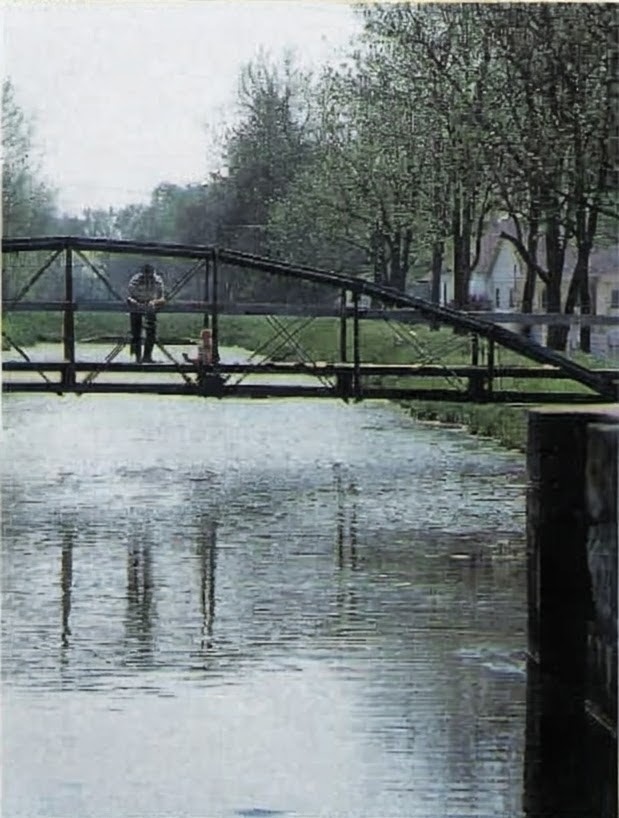
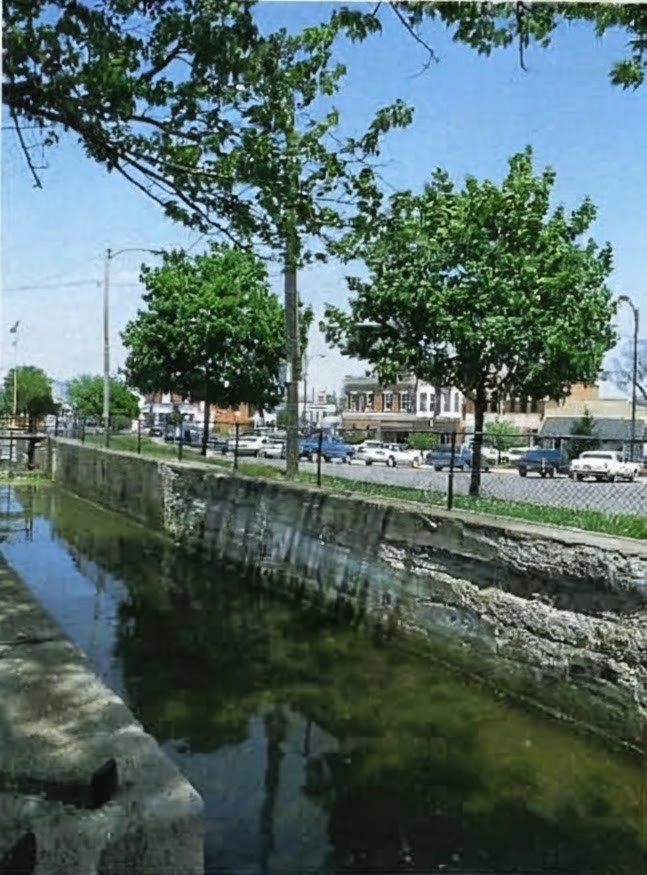
In New Bremen, we drive beside the old canal, still intact in the heart of the little town, and find Reuben Thiesing in his workshop, covered with sawdust and surrounded by a house he has built, which is full of the salvaged parts of other houses. His own house, which he also built, is next door, and across the alley is another house that he’s restoring. Mr. Thiesing splendidly represents traits seen as Germanic cliches: frugality, craft and order. All the salvaged parts are stacked neatly away, almost filed. Even the sawdust of the shop is saved and used on an unfinished walk. His work is fine and eccentric, brick walls suddenly turning to stone, and in the kitchen of his wife, Sarah, an island built atop a heat register that provides a warm place to eat breakfast and to dry towels.
“How do you lay this?” asks Ms. Brown, looking at a sidewalk, obviously salvaged, then put meticulously back together. “You don’t ask how to do it,” says Mr. Thiesing. “You pick it up and you put cement on it! That’s how you do it.”
His real passion, however, is the making of cabinets, which he will create in the most unlikely places. “One must look at the wood, and see the furniture,” he says. “That is all. My problem is, I see it, then I have to do it. It’s a sickness. My dad used to say to me, ‘If you get careless, who’ll they get?’ He meant that then everybody would be the same.”
Another example of It wasn’t the way I wanted it, which, in its best expression, accounts for a cultural wealth of discipline, frugality and order that parallels and enhances the rich farms. They are traits going solidly backward to the old authoritarian, Brunner, and the audacious immigrants who stepped off the canalboat with their shirt sleeves already rolled. It was the discipline of faith, common sense and muscle, an aggregate expression still so evident here that if it weren’t for the pickup trucks and the farm equipment, one might think the farmsteads were Amish.
“The land is plentiful,” wrote Elisabeth Boeke, “and all else is scarce; therefore, only courage, frugality and industry will bring assured returns . . .”